

Running and lifting on the same day works fine as long as you space the two sessions six to eight hours apart — the closer together they sit, the more the interference effect eats into your strength gains. Get the spacing right and you can build muscle and endurance in the same week without either one stalling out.
Most hybrid programs hand you a template, wish you luck, and never touch the part that actually breaks people: scheduling. They tell you to run and squat in the same week and hope for the best, without ever explaining how close is too close. Meanwhile your body is treating those two sessions as competing bills that both came due on the same day.
That’s the real question behind running and lifting on the same day. It’s not about grit. It’s not about “wanting it more.” It’s about respecting how a human nervous system actually recovers from two very different demands. Nail the timing, and you get a body that can grind out a heavy set of five and still show up for a tempo run hours later. Miss it, and you’re just tired all the time, plateaued on both fronts, wondering why the plan you found on Instagram isn’t working.
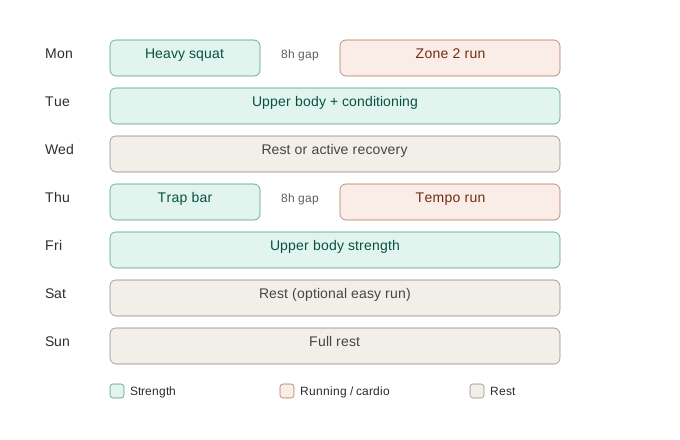
This piece breaks down exactly how much space you need between a run and a lift, plus the four-day split we run with Bodylix clients who’ve bounced between pure strength blocks and pure running plans, never quite satisfied with either. There’s a weekly matrix graphic below showing exactly where your heavy leg day sits relative to your zone 2 runs, plus the recovery rules that make the whole structure hold together.
Table of Contents
- Why Running and Lifting on the Same Day Goes Wrong
- Rule 1: Movement Quality Over Total Load
- Rule 2: The 8-Hour Spacing Rule
- The Complete 4-Day Bodylix Hybrid Split
- How to Warm Up for Hybrid Training
- Recovery Protocols: Sleep, HRV, and Calories
- Common Mistakes
- FAQ
Why Running and Lifting on the Same Day Goes Wrong (The Interference Effect)
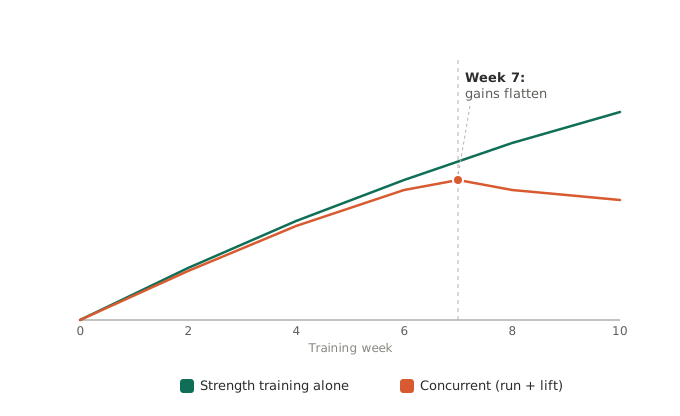
The interference effect is what happens when endurance training blunts the strength and muscle gains you’d normally get from lifting alone — and it’s been documented since 1980. Exercise physiologist Robert Hickson ran a ten-week study putting three groups through strength-only, endurance-only, and combined training. The strength-only group kept climbing in max strength for the full ten weeks. The concurrent group improved right alongside them — until week seven, when their strength gains flattened out and then dropped, even though their aerobic fitness kept improving fine.
That’s the interference effect in a nutshell: concurrent training doesn’t hurt your cardio, but past a certain point it starts eating into your strength.
Here’s the part most hybrid programs skip. A wave of research since 2012, including work covered by Stronger by Science and a growing pile of newer trials, has walked that original finding back quite a bit. For people who aren’t already advanced lifters, and for anyone who separates their hard sessions properly, the interference effect shrinks dramatically or disappears. A 2024 review in the Journal of Strength and Conditioning research space found separating sessions by six or more hours meaningfully protects both running economy and strength output. The NSCA’s own guidance says something similar: don’t stack a high-volume, high-intensity lift and a high-volume, high-intensity run on the same day. One of them needs to back off.
So the problem was never running and lifting on the same day. It’s doing it without any thought to spacing.
When you stack a brutal leg day and a hard interval run within a couple of hours of each other, your body’s facing a recovery bill it literally cannot pay off in time. Both sessions are drawing from the same well — your central nervous system, your glycogen stores, your local muscle tissue. Ask for max output from both in the same afternoon and something gives. Usually it’s the lift
Rule 1: Prioritize Movement Quality Over Total Load
The fastest way to wreck a concurrent training block is chasing bigger numbers on both fronts in the same week. More mileage on the run. More plates on the squat. Same seven days. Your body doesn’t have a second gear for “adapt to everything at once.”
Think of your training week as a set of stressors you’re managing, not a checklist you’re clearing. Heavy strength work and hard running are pulling from the same recovery account. Stack them too close and neither withdrawal clears before the next one hits.
The fix is boring but it works: pick your hardest effort for the day and let that be the day’s job. Squatting heavy? That’s the stressor. Running intervals? That’s the stressor. Don’t try to PR both in the same 24-hour window — you’ll likely bomb one, sometimes both.
Quality beats a number on the bar every single time in concurrent training. If your squat depth is falling apart or your running form is breaking down under fatigue, you’ve stopped training the pattern and started just accumulating wear and tear. Load is a tool. It’s not the scoreboard.
Bodylix coaches see this constantly with new hybrid clients: someone shows up wanting to hit a five-rep max on squats the same morning they ran six miles hard the night before. They’re not weak. They’re just asking their body to do something it physically can’t do well twice in a row.
Rule 2: The 8-Hour Spacing Rule
This is the rule that actually changes outcomes.
Running and lifting on the same day is fine — the gap between the two sessions is what decides whether you get real adaptation or just interference. A 2024 PMC-published review on training sequence found separating sessions by at least six hours protected both strength output and running economy — eight hours is even safer if your schedule allows it.
Why does the gap matter so much? Residual fatigue from a hard run lingers well past the shower. It’s neuromuscular, it’s metabolic, it’s mechanical, all three at once. Try to squat under that fatigue and you get fewer quality reps, less force, and honestly a weaker signal for your muscles to grow from. You’re not really training at that point — you’re surviving the workout.
Give your body six to eight hours and your nervous system gets a real reset. Your muscles clear out the metabolic mess. You go back to being able to produce something close to your actual max force output.
Can’t hit that window? Put the sessions on separate days entirely. A Monday squat session paired with a Tuesday run beats a Monday-morning squat and Monday-afternoon run separated by three rushed hours, every time.
And if same-day training is genuinely unavoidable: lift first. Always. Your heavy lifting suffers far more from pre-fatigued legs than an easy run suffers from tired ones. Easy running on tired legs is fine — mildly annoying, sure, but fine. Heavy squatting on cooked legs is how you strain something.
The Complete 4-Day Bodylix Hybrid Split (Strength + Cardio)
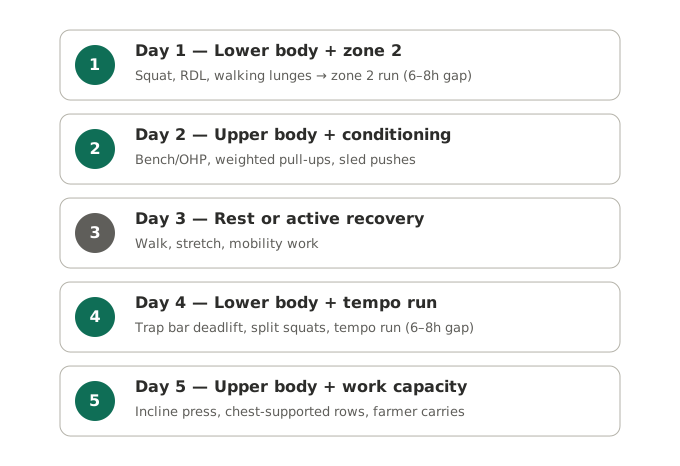
This hybrid training split assumes four training days a week, built for someone who wants real strength and muscle while holding onto (or improving) their aerobic engine. It’s not a marathon taper. It’s a physique-and-performance plan for people who want to look athletic and actually perform like it.
Day 1 — Lower Body Strength + Easy Aerobic Work
Open the week with your heaviest lower-body session while your nervous system is still fresh off the weekend.
- Back squat: 4 sets of 4–5 reps, one rep in reserve
- Romanian deadlift: 3 sets of 6–8 reps
- Walking lunges: 3 sets of 8 reps per leg
- Loaded carries: 3 rounds of 40 meters
Cardio lands six to eight hours later, or the next morning. Zone 2 run or bike, 30–40 minutes, conversational pace the whole way. Non-negotiable rule here: squat in the morning, run that evening. Squat in the evening, run the next morning before breakfast.
Day 2 — Upper Body Strength + Short Conditioning
- Bench press or overhead press: 4 sets of 4–5 reps
- Weighted pull-ups or heavy rows: 4 sets of 5–6 reps
- Dips: 3 sets of 6–8 reps
- Face pulls: 3 sets of 12–15 reps
Then conditioning — sled pushes or hill sprints, 6–8 rounds of 20–30 seconds, with generous 90–120 second rest between rounds. This is power output work. It’s not meant to leave you gasping on the floor.
Day 3 — Rest or Active Recovery
Walk. Stretch. Do your mobility work. Eat enough protein. This day is what makes Days 1, 2, and 4 actually pay off. Skip it regularly and your hybrid training plan stalls — not eventually, pretty fast.
Day 4 — Lower Body Hypertrophy + Tempo Run
- Trap bar deadlift: 4 sets of 6–8 reps
- Bulgarian split squats: 3 sets of 8–10 reps per leg
- Hamstring curls: 3 sets of 10–12 reps
- Box jumps: 3 sets of 3 reps — explosive quality, not volume
Cardio’s a separate session today: tempo run, 15–20 minutes, at roughly the pace you could hold for an hour of racing but wouldn’t call comfortable.
Day 5 — Upper Body Hypertrophy + Work Capacity
- Incline dumbbell press: 4 sets of 8–10 reps
- Chest-supported rows: 4 sets of 8–10 reps
- Lateral raises: 3 sets of 12–15 reps
- Farmer carries: 4 rounds of 40 meters
Optional finisher: 10 minutes on a bike or rower, moderate effort. Skip it if you’re running low on gas that week.
Days 6 and 7 — Rest
A short easy run on one of these is fine if your recovery’s solid. Don’t force it just because the calendar says “rest day feels lazy.” Recovery is where the actual adaptation happens — not during the workout itself.
How to Warm Up for Hybrid Training
Skipping the warm-up, or rushing through five sloppy leg swings, is one of the most common ways hybrid athletes injure themselves. You’re asking your body to handle two very different movement demands across the same week — it deserves more than an afterthought.
Match your warm-up to the day. On lower-body strength days, work hip mobility, ankle mobility, and glute activation before you touch a bar. On running days, lean into dynamic stretches that open the hips and wake up the posterior chain.
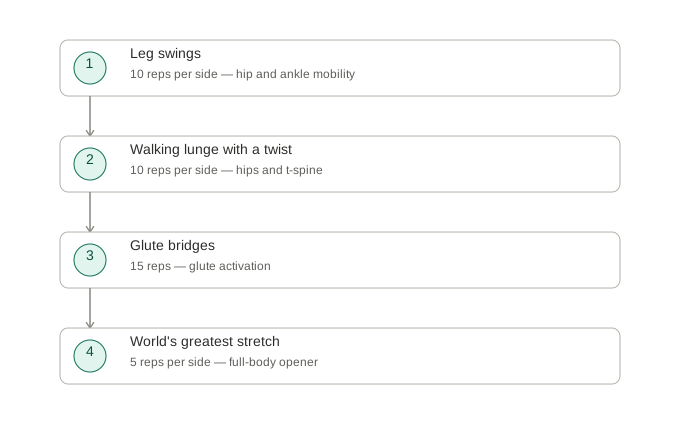
A sequence that works before nearly any hybrid training session:
- Leg swings, 10 reps per side
- Walking lunge with a twist, 10 reps per side
- Glute bridges, 15 reps
- World’s greatest stretch, 5 reps per side
Five to eight minutes, that’s it. Skip this for a few months and you’ll find out the hard way why coaches keep harping on it.
A cheap set of resistance loop bands makes glute bridges and lateral work noticeably more effective if you don’t already own a pair.
Recovery Protocols: Sleep, Heart Rate Variability, and Calories
You cannot out-program bad recovery. Full stop. The real edge a hybrid athlete has isn’t their work capacity — it’s how well they recover between sessions, and that’s where most people quietly fail.
Sleep comes first. Seven to nine hours, most nights, not “six on weekdays and catch up Saturday.” The hormonal environment that repairs muscle and resets your nervous system gets built during consistent sleep, not a nap and a prayer. Shortchange this and nothing else here matters much.
Heart rate variability works as an early warning light. If you track it, a noticeable dip below your baseline usually means you haven’t recovered from your last session. On those mornings, dial back intensity or swap in active recovery. Pushing through a low-HRV day rarely produces a good session — mostly it just digs the hole a bit deeper. If you don’t already track HRV, a wearable like the Oura Ring 5 makes the daily trend easy to see instead of guessing at how you feel.
Calories and protein fuel the whole operation. Building muscle and endurance at the same time takes real fuel — under-eating is the single fastest way to feel awful three weeks into a concurrent training block. Aim for roughly 0.7 to 1 gram of protein per pound of bodyweight. Don’t fear carbs, either — they refill glycogen for tomorrow’s run and tomorrow’s lift.
Hydration matters more than people give it credit for. Dehydration tanks strength output and makes an easy run feel like a slog. Drink water steadily through the day, and add electrolytes around your hardest sessions.
Common Mistakes Hybrid Athletes Make
Even with a good plan on paper, the same handful of mistakes show up over and over.
Doing too much too soon tops the list. You can’t jump from a casual three-day gym routine to six hard hybrid sessions a week. Add one running session per week, let your body adjust, then add the next.
Ignoring easy days is another. Easy running isn’t junk mileage — it builds your aerobic base without draining the recovery your lifts need. If every run feels hard, you’re not training. You’re piling on fatigue.
Dropping strength work the moment running volume climbs is one we see constantly. Resist it. Strength training protects your joints and keeps power output up even as mileage grows. Trim the volume if you need to, but keep the sessions.
Not eating enough shows up as constant soreness and low energy that never resolves. If that’s you, you probably just need more food.
Comparing yourself to specialists ends most hybrid training attempts. You’ll never out-squat a dedicated powerlifter or out-run someone who trains for nothing else. That was never the point. Judge your progress against your own numbers from three months ago, not a specialist’s.

Frequently Asked Questions
How many hours should I space lifting and running?
Six to eight hours minimum if you’re running and lifting on the same day — eight is safer. Can’t manage that gap? Put the two sessions on separate days instead so residual fatigue clears before you ask for max output.
Is running and lifting on the same day bad for you?
No, not if you space it right. The interference effect is real, but it mainly bites when the sessions sit within an hour or two of each other. Six to eight hours apart, and most recreational lifters see no meaningful downside.
Should I run before or after lifting?
Lift first if both have to happen in one session. Running before lifting hurts your strength work far more than lifting beforehand hurts an easy run.
Can I build muscle and endurance at the same time?
Yes. With the sessions spaced properly and total volume kept reasonable, concurrent training can produce strength and muscle gains close to what you’d get from lifting alone, especially if you’re not already an advanced lifter.
How many days a week should a hybrid athlete train?
Four focused days works well for most people balancing strength and endurance goals. Push past that and recovery — not your programming — becomes the bottleneck.
What’s the best cardio for hybrid training?
Zone 2 running and cycling build your aerobic base without piling on excess fatigue, which makes them the safer default. Tempo runs and hill sprints have their place, but use them sparingly.
How long before I see results from hybrid training?
Most people notice better work capacity within four to six weeks. Strength and visible muscle changes take longer — usually eight to twelve weeks of consistent training and eating enough.
Can beginners do hybrid training?
Yes, but start conservative. Build a base in one discipline first, then layer in the second. Trying to learn both at high intensity from day one is a fast route to burnout or injury.
What should I eat before and after training?
A mix of protein and carbs one to two hours before a session. Protein and carbs again within an hour after. Your total daily intake matters more than nailing the exact timing.
The Bottom Line
Running and lifting on the same day doesn’t fail because the goal is unrealistic. It fails because most programs ignore the interference effect and treat the two as interchangeable forms of exercise.
They’re not. They’re two stressors competing for the same recovery. Your job — the entire job, really — is sequencing them so your body can actually adapt to both.
Space your hardest sessions. Sleep like it’s part of the program, not an afterthought. Eat enough to support the work you’re asking your body to do. When you’re unsure, default to quality over quantity, whether that’s on the platform or on the road.
Start with the four-day split above. Get your recovery dialed in before you touch the volume. Adjust based on how you’re actually recovering, not how you think you should feel. That’s the difference between a six-week hybrid training phase that fizzles out and years of training that actually holds up.
This article reflects general training guidance and current exercise science. Individual results vary based on training history, recovery capacity, and health status. Consult a physician or qualified coach before starting a new training program, especially if you have existing injuries or health conditions.
This post contains affiliate links; we may earn a commission at no cost to you” covers it.
Related on Bodylix: Cardio Versus Strength Training: Which Is Better for Your Goals? · Walking vs. Running for Weight Loss: Which Actually Works Better? (Science + Real Results) Workouts for Obese Beginners at Home: A Gentle, Safe Plan to Lose Belly Fat
Sources: NSCA — Integration of Endurance and Resistance Training · PMC — Effect of Strength and Endurance Training Sequence on Endurance Performance