
10-Minute Full Body Workout for Beginners (No Equipment Needed)
Most fitness advice is written for people with plenty of time and a garage full of gear. If you’re just starting out, short on time, or working entirely from home, that doesn’t help. This routine is built for you — zero equipment, 10 minutes total, and designed to grow with you.
Quick-Reference Routine At a Glance
| Exercise | Time On | Rest | Targets | Beginner Modification |
|---|---|---|---|---|
| Jumping Jacks | 40s | 20s | Full-body cardio | Step side-to-side — no jumping |
| Bodyweight Squats | 40s | 20s | Legs, glutes, core | Hold a chair for balance |
| Push-Ups | 40s | 20s | Chest, shoulders, arms | Do on knees / hands higher on a wall |
| Reverse Lunges | 40s | 20s | Legs, balance | Shorter step, hold a chair or wall |
| Plank Hold | 40s | 20s | Entire core | Drop to knees / hold 20s instead |
| Mountain Climbers | 40s | 20s | Cardio + deep core | Slower pace, keep knees lower |
| Total | 4 min | 2 min | + repeat ×2 = 10 min | |
Why 10 Minutes Actually Works
You know that feeling — you plan to move, then the day disappears. By 9 p.m. you’re on the couch wondering where the hours went. You’re not lazy. You’re just busy, and most workout advice skips people like you.
I remember telling newcomers at the fitness center about just 10-minute full-body sessions — they didn’t believe it could work. They were used to seeing people spend one, sometimes even two hours at the gym to get in shape. But after three weeks of showing up consistently, they were the ones telling others: 10 minutes really does move the needle. Results weren’t just real — in some cases, they were better, because this was something they actually stuck with.
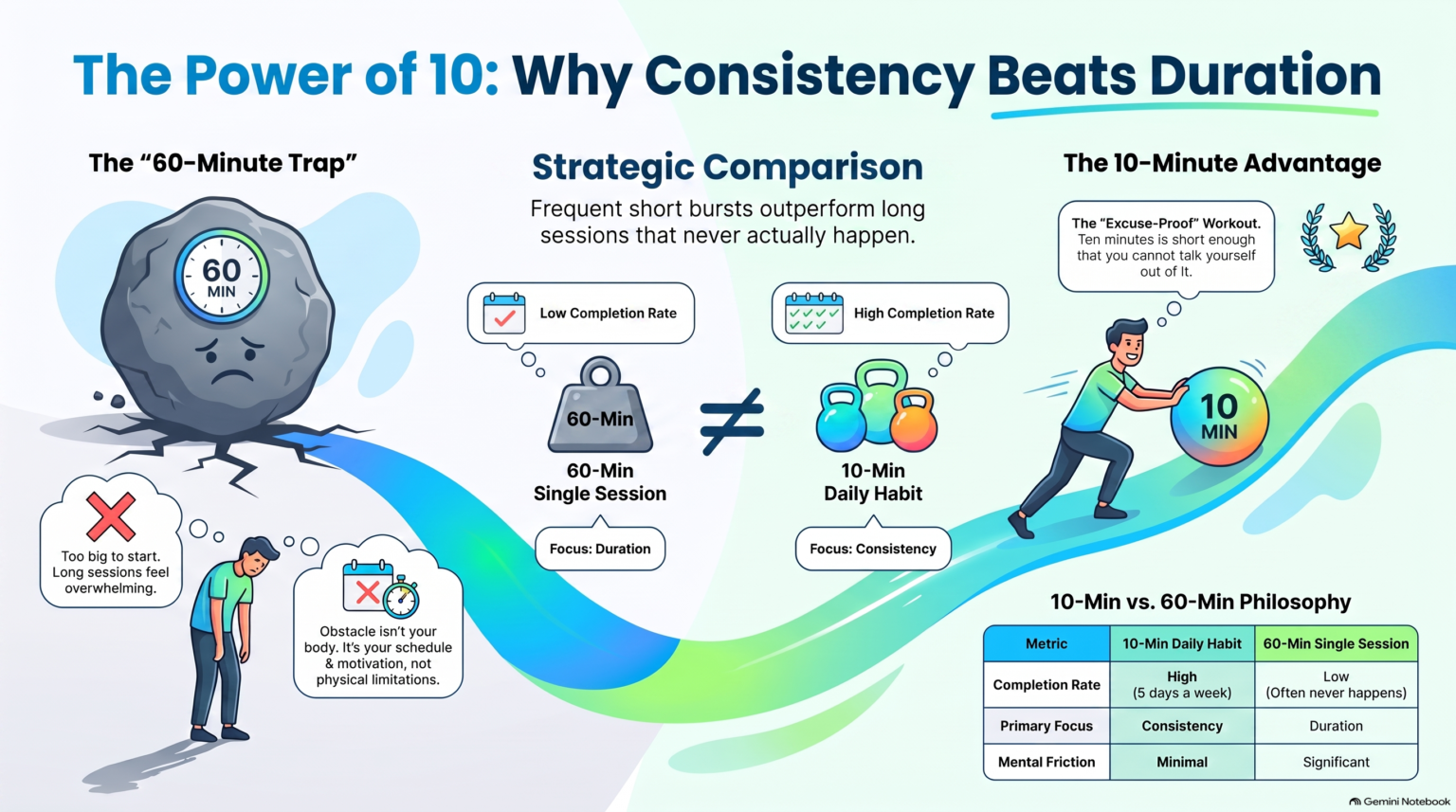
That’s the secret nobody talks about: consistency beats duration, every single time. Someone who shows up for 10 minutes five days a week will almost always outperform someone who plans a 60-minute session that never happens. Ten minutes is short enough you can’t negotiate yourself out of it. There’s no valid excuse against “it’s only 10 minutes.”
Every move here hits multiple muscle groups at once. You’re not wasting time on exercises that isolate one tiny part while ignoring the rest. Legs, chest, back, core, heart — all covered. Your own body weight is plenty of resistance when you’re starting out. You don’t need a barbell to build strength. You need consistent effort and movements that challenge your body the right way.
More beginner-friendly routines: More no-equipment home workout guides
The Full 10-Minute Routine
Do each exercise for 40 seconds, rest 20 seconds, then move on. Complete all six once for your 10-minute session. Feeling stronger? Run through twice for a 20-minute version.
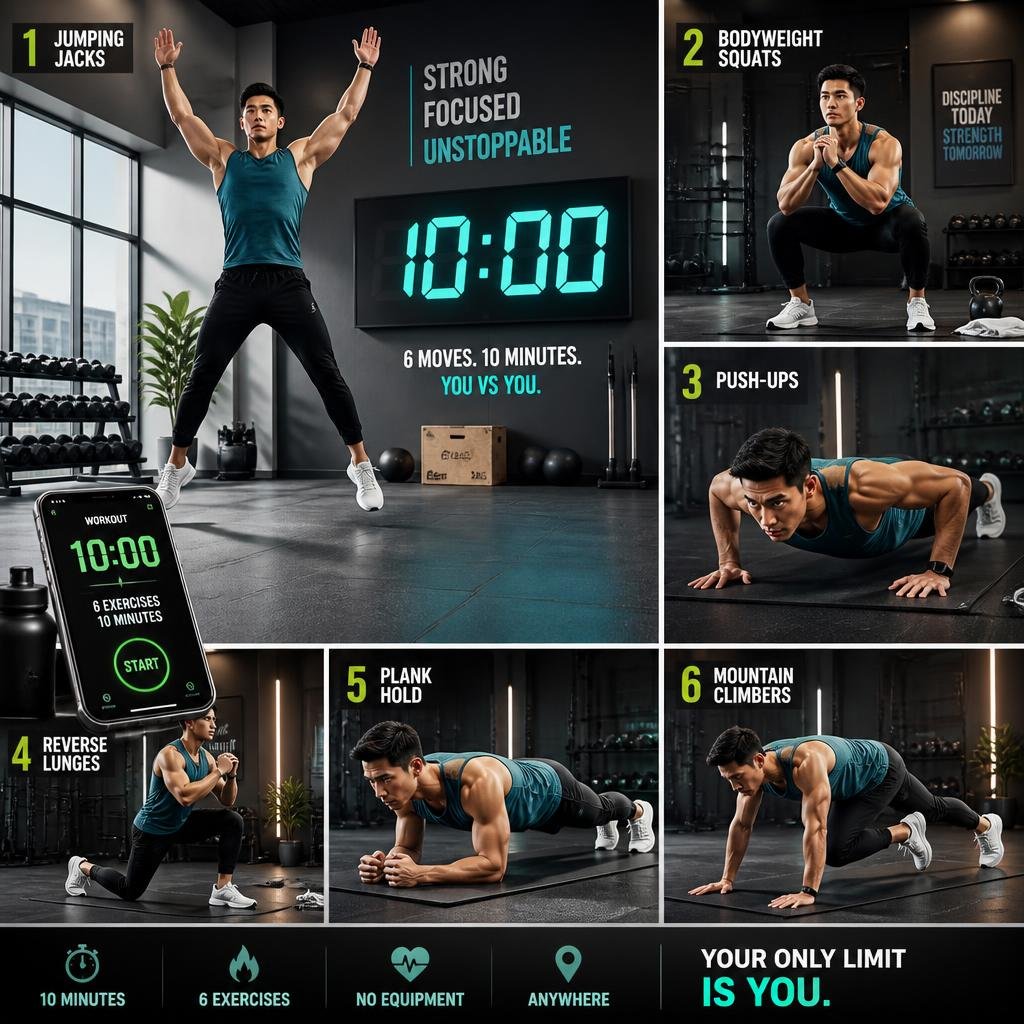
1. Jumping Jacks — Warm Everything Up
Stand tall, feet together, arms at your sides. Jump feet out while raising arms overhead, then return. Gets your heart rate up and loosens shoulders and hips before you ask more of them.
Low-impact fix: Step one foot out at a time instead of jumping — same benefit, zero joint impact.
2. Bodyweight Squats — Legs & Glutes
Feet shoulder-width apart. Push hips back like sitting in an invisible chair, bend knees, lower until thighs near parallel. Drive through heels to stand. Keep chest lifted — don’t round your back.
Mod: Place a chair behind you and tap it lightly before standing back up.
3. Push-Ups — Chest, Shoulders & Arms
Start in plank, hands under shoulders. Lower chest toward floor, elbows at roughly 45°, then push back up.
Mod: Drop to knees. Or do them against a wall. That’s not cheating — that’s smart training. Everyone starts somewhere.
4. Reverse Lunges — Balance & Lower Body
Step one foot back, lowering until both knees near 90°, front knee stacked over ankle. Push through front heel to stand, switch sides. Go slow and controlled — speed doesn’t help here.
Mod: Keep steps shorter, or lightly hold a wall for balance.
5. Plank Hold — Your Entire Core
Forearms and toes on floor, body straight from head to heels. Don’t let hips sag or pike up. Breathe steadily. This is the one most people want to rush — and the one your core needs most.
Mod: Drop to knees. Hold 20 seconds, build from there.
6. Mountain Climbers — Cardio + Core
From plank, drive one knee toward chest, switch quickly like running horizontally. This spikes your heart rate one last time — that’s where extra calorie burn and cardiovascular benefit kick in.
Mod: Go slower, keep knees lower, don’t rush the pace.
That’s it. Six moves. In the time it takes to watch two YouTube ads, you’ve trained your whole body.
4-Week Progression Plan — Keep Getting Stronger
A static routine stops working after a few weeks. Here’s exactly how to ramp it up gradually so you keep seeing progress without burning out:
| Week | Work Time | Rest Between Exercises | Rounds | Estimated Calorie Burn* |
|---|---|---|---|---|
| Week 1 | 30 seconds | 30 seconds | 1 full round | ~60–80 calories |
| Week 2 | 40 seconds | 20 seconds | 1 full round | ~80–100 calories |
| Week 3 | 40 seconds | 20 seconds | 2 rounds (5 min break between) | ~120–150 calories |
| Week 4 | 45 seconds | 15 seconds | 2 rounds (short 30s break only) | ~150–180 calories |
*Numbers estimated for 60–70kg person — adjust up or down based on your size and effort level.
After Week 4? Either keep building toward 3 rounds or add targeted work like glute-specific exercises to add to your routine on alternate days.
Alternative Versions — For Every Space & Need
Jumping isn’t always an option. Here’s how to adapt this routine to your situation:
| Version | Key Changes | Who This Is For |
|---|---|---|
| Standing Only | Replace plank → marching; mountain climbers → side steps with arm raises | Bad wrists, no clear floor space |
| Low-Impact | No jumping: jacks = side steps; climbers = slow standing knee drives | Knee issues, joint sensitivity, recovering from injury |
| Apartment-Friendly | Low-impact moves + land softly on carpet/mat; no loud steps | Living above someone, shared spaces |
| 20-Min Extended | Full circuit twice, plus 2 min brisk walk between rounds | When you have extra time and want more results |
For a fully joint-friendly routine built specifically for this need: Low-impact version for gentle, sustainable progress
Warm-Up & Cool-Down — Don’t Skip These
Top fitness sites always include these for a reason: they prevent soreness, protect your joints, and help you get more from every session.
Warm-Up — 5 Minutes Before You Start
- March in place, pumping arms — 1 minute
- Arm circles forward and backward — 30 seconds each direction
- Hip circles, hands on hips — 30 seconds each direction
- Ankle rolls, one at a time — 30 seconds each
- Gentle standing torso twists — 1 minute
Cool-Down — 3 Minutes After You Finish
- Standing forward fold (knees soft) — 30 seconds
- Standing quad stretch — 30 seconds per leg
- Clasp hands behind back, open chest — 30 seconds
- Child’s pose on floor — 1 minute
Common Mistakes & How to Fix Them
Going too fast. Speed isn’t the goal — form is. Rushing through squats or push-ups with sloppy technique raises injury risk and lowers how much benefit you actually get. Slow down. Feel the muscle working.
Holding your breath. It happens constantly, especially during planks and push-ups. Breathe out on the effort, breathe in on the release. Your muscles need oxygen to perform.
Skipping rest periods. Twenty seconds feels short, but it’s there for a reason. Your body needs that brief recovery to maintain good form on the next exercise.
Comparing yourself to others. The person demonstrating online has trained for years. You’re comparing your beginning to their middle. That’s not fair — and it’s not useful either.
Frequently Asked Questions
Can I do this every day?
Three to five days per week is ideal. Your muscles adapt and get stronger during recovery, not during the workout itself. On off days, take a walk or do gentle stretching — full rest is perfectly fine too.
Will this help lose belly fat?
This routine builds the muscle that boosts your metabolism. Visible fat loss comes from combining consistent movement with eating slightly fewer calories than you burn. Fuel your progress with high-protein, nutrient-dense meals and give it time — consistency beats intensity every time.
I’m overweight or completely new — is this okay?
Absolutely. That’s exactly who it was built for. Start with the Week 1 plan and use every modification listed. One round is plenty for your first few sessions. Showing up matters more than how hard you push.
How long until I see results?
Most people notice easier movement and better energy in 2–3 weeks. Visible changes usually show around 4–8 weeks. Take a photo every two weeks — the mirror lies day to day, but side-by-side photos don’t.
Can I add this to walking or other activity?
Yes — do this workout first while your energy is fresh, then go for your walk. The combination builds fitness faster than either alone.
Do I need equipment eventually?
Not to start. If you want to make the space more comfortable, a good mat goes a long way.
Recommended Gear
Gaiam Thick Yoga Mat — softens hard floors, prevents slipping, and makes floor moves much more comfortable.
View on Amazon →Follow Along — Video Version
Prefer moving with someone on screen? Follow along:
What I’d Actually Do
If I were starting from zero tomorrow? I’d ignore the full 4-week plan for the first week. I’d pick one exercise — probably squats — and do one set right after brushing my teeth. That’s it.
A habit has to exist before a schedule can sit on top of it. Once showing up feels normal, you add the rest. That’s also why we built the 30-Day Fitness Reset — complete system for building lasting habits ($27 one-time) — it turns “I should” into “I did” for 30 days straight.
And if you’re looking for whole-body wellness beyond just movement? RhythmONE offers a targeted blend designed to support memory function and overall well-being — learn more here.
Disclaimer. This article is for educational purposes only and is not medical advice. Results vary from person to person. If you have existing health conditions or are unsure whether a new exercise routine is right for you, please consult a healthcare professional before starting. Stop immediately if you feel sharp pain, dizziness, or distress.
Sources
Word count: ~2,420 words · For more practical home workouts, visit bodylix.com

Fitness Specialist & Former Tactical Trainer
Bal Krishna Poudel has spent more than 19 years in law enforcement organization, and fitness has been at the center of it all. He knows physical conditioning, dynamic strength training, and everyday wellness inside and out. For close to two decades, he taught at official police training centers, getting officers ready for the physical demands of the job—building their endurance and operational fitness. These days, he coaches people in his local community on strength and fitness. At 49, he doesn’t just talk about staying active—he lives it, showing up every day to train and move. He writes for Bodylix, where he shares workouts and nutrition advice that regular readers can actually use, backed by science and built around one goal: helping people stay strong and healthy for the long haul.

5 Responses