
Glutes Workout at Home: The No-Equipment Plan That Actually Builds Muscle
Most glute routines I see online are the same twelve moves in the same order, fifteen reps each, done while someone half-watches a video. Then people wonder why nothing changes. A proper glutes workout at home doesn’t need a bench, a bar or a gym fee. It needs a floor, a sturdy chair, about 25 minutes, and sets that actually get hard. This guide covers all of it, plus what to check when your progress stalls.
Below you’ll find why it works without weights, one session for tonight, how to adjust things for your goal, the numbers for sets and reps, and a fix list for stalled progress. I’ll also say which popular moves I’d drop.
Can you really grow glutes without weights?
Yes. Muscle can’t tell a barbell from your own bodyweight. It reacts to how hard the set was.
A 2017 meta-analysis compared light and heavy loads and found similar muscle growth when the light sets went close to failure [1]. That’s the whole reason bodyweight glute exercises work, and they get ugly quickly once you move to one leg.
Some quick anatomy, since it decides which moves matter. You’ve got three glute muscles. The maximus is the large one that builds most of the shape. The medius and minimus sit higher on the side and stop your pelvis dipping when you stand on one leg. Because the maximus does most of the work, you want moves where your hips push forward against resistance: bridges, thrusts, step-ups, lunges.
Growth needs hard sets, enough of them, and patience. One review found people doing 10 or more weekly sets for a muscle group gained more than people doing under five [2]. Patience just means you keep turning up.
I’m not a fan of chasing the burn. Fast little kickbacks make your glutes sting, and plenty of people do them for months with nothing to show for it. Think about two people at home. One bangs out a hundred quick kickbacks and feels wrecked. The other does three slow sets of single-leg bridges and barely feels anything until the eighth rep. I’d put my money on the second.
Fair warning, though: your glutes might feel half asleep for the first two weeks. You squeeze, and your thighs jump in to help. If you sit all day, that’s pretty normal. Slow the reps down, pause at the top, and it mostly sorts itself out.
And since you can’t strap 10 kilos to yourself at home, you make exercises harder by changing them. Go to one leg. Lower more slowly. Rest your shoulders on a couch. We’ll get to those.
Start tonight: a 25-minute session
If you were after an at home glute workout no equipment needed, here it is. Do it three days a week with a day off in between. Before you start, spend two minutes on 10 squats and 10 easy bridges.
- Glute bridge, 3 sets of 15. Lie on your back with knees bent and feet flat, roughly hip-width. Push through your heels until your shoulders, hips and knees make one line. Hold for two seconds, then take a full three seconds to lower. Rushing the way down is the usual mistake.
- Reverse lunge, 3 sets of 10 per leg. Step one foot back, let that knee drop toward the floor, then drive up through the front heel.
- Chair step-up, 3 sets of 10 per leg. A sturdy chair or the bottom stair is fine. Lean forward slightly and try not to spring off the back foot.
- Single-leg Romanian deadlift, 2 sets of 10 per side. Bend the standing knee a little, hinge from the hips, and let the other leg float out behind you.
- Side-lying leg raise, 2 sets of 15 per side. Slowly, toes pointing forward.
A few small things that matter. For step-ups, choose a chair height where your knee ends up around hip level, not higher. For the deadlift, imagine pushing your hips back toward a wall behind you and keep your back flat. If you wobble, rest a fingertip on a wall. Nobody’s watching, and it beats falling over.
Rest about a minute to ninety seconds between sets. It all lands near 25 minutes. Walk on a couple of your off days if you like. And don’t add extra finisher sets just because you’ve got energy left. If you’ve got energy left, the earlier sets weren’t hard enough.
Getting the glute bridge at home right
Everyone rushes the glute bridge at home because it looks too easy to bother with. The common mistake is arching your lower back at the top. If your back is doing the lifting, tuck your ribs down and stop a little lower. You should feel it behind your hips. Feeling it in your hamstrings? Move your feet in closer.
The 25-rep test
This is the only calculator you need. If you can do more than 20 to 25 clean reps of something, it’s too easy, so change the move instead of adding reps. If you can’t reach 8, step back to an easier version.
Unlock Your Glutes
A guided glute program for anyone who’d rather follow a set plan than build their own.
Learn more →This page may contain affiliate links. If you buy through them, Bodylix may earn a commission at no extra cost to you. This is general information, not medical advice.
Different goals, different tweaks.
Same moves, different settings. Pick what fits.
If you want bigger glutes
How to grow glutes at home comes down to one rule: make something harder every week. One more rep, a slower lowering phase, a tougher variation, a backpack stuffed with books. Stay in the 8 to 15 rep range, stop a rep or three before failure, and give your main hip move four sets. The backpack really does work, and it beats most of the gadgets I’ve come across.
If you want to lose fat and tone up
No move burns fat off your glutes specifically, whatever the ad says. Fat leaves based on what you eat and how much you move overall. The training keeps the muscle underneath, and that’s what makes the shape show up. Keep the same workout, walk 30 minutes a day, and look at our list of low-calorie, high-protein foods so dinner works with you. If you’d like it all mapped out, the $27 30 Day Reset program does that.
If you’re brand new
Start with two days a week and two sets a move. For the first three weeks, stay with two-leg bridges, squats to a chair, and a step-up where you can hold onto something. Our simple exercises for beginners at home fit nicely beside this. Learn the shape of each move before you make it harder.
If you’ve trained before
Skip ahead to the one-leg stuff: single-leg hip thrusts with your shoulders on the couch, Bulgarian split squats with a back foot on a chair, three seconds down on everything.
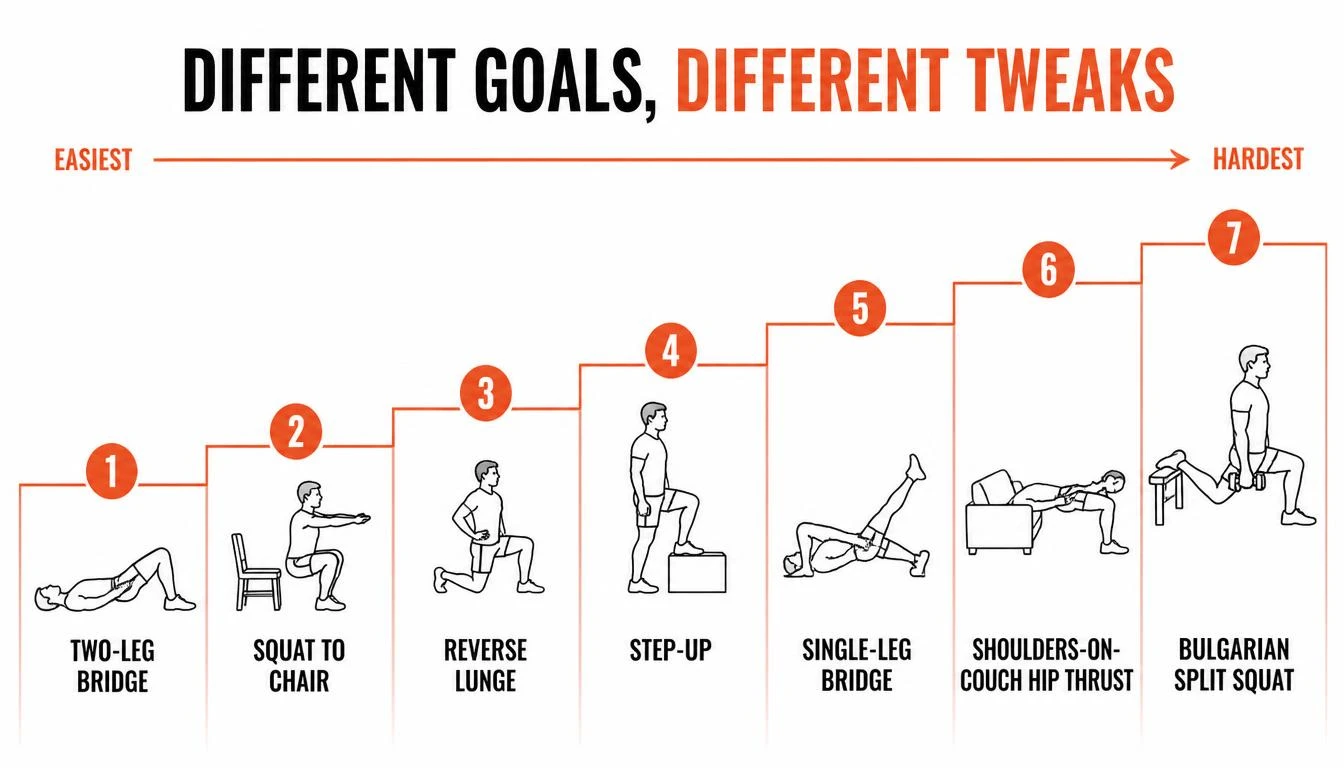
The bodyweight glute exercises ladder
Roughly easiest to hardest, it goes like this: two-leg bridge, squat to a chair, reverse lunge, step-up, single-leg bridge, hip thrust with your shoulders on the couch, then Bulgarian split squat. Move up a rung once 20 clean reps feels comfortable. And don’t skip ahead because the harder one looks better on Instagram.
What would I drop? Donkey kicks and fire hydrants as your main work. They don’t load the glutes much. Fine at the end of a session if you’ve got time, pointless as the centerpiece.
How many sets, reps, and days do you need?
For any glutes workout at home, aim for two or three sessions a week, 10 to 15 hard sets for your glutes across the week, and most sets finishing a few reps short of failure.
- Adult guidelines recommend muscle-strengthening work at least two days a week [3], and the ACSM points newer lifters to two or three [4].
- If you’re new, start nearer 8 weekly sets and build toward 10 to 15.
- Reps can run anywhere from 8 to 25 depending on the move. The end of the set should hurt, not the start.
- Rest 60 to 90 seconds, lower for three seconds, squeeze for a second or two at the top.
- Expect to feel stronger around week three or four. Visible change usually shows up somewhere between weeks 8 and 12, as long as your eating and sleep aren’t terrible.
Progression is less mysterious than people make it. Choose a range, like 8 to 12. Stay on a move until you hit 12 reps on every set with clean form. Then switch to a tougher version, drop back to 8, and climb again. That loop keeps a home plan working long after week four. Log your reps in your phone after each set so you’re not guessing.
Food counts too. A big meta-analysis found extra protein stopped adding muscle around 1.6 grams per kilo of bodyweight a day [5]. At 70 kilos that’s about 112 grams. Not sure how to hit it? Our guide on how much protein per day breaks it down. And sleep seven hours if you can.
Skip the daily glute session. More isn’t faster here. Tired glutes make sloppy reps, and sloppy reps don’t build anything.
Why aren’t your glutes growing?
Weeks in and nothing’s moved? It’s usually one of these.
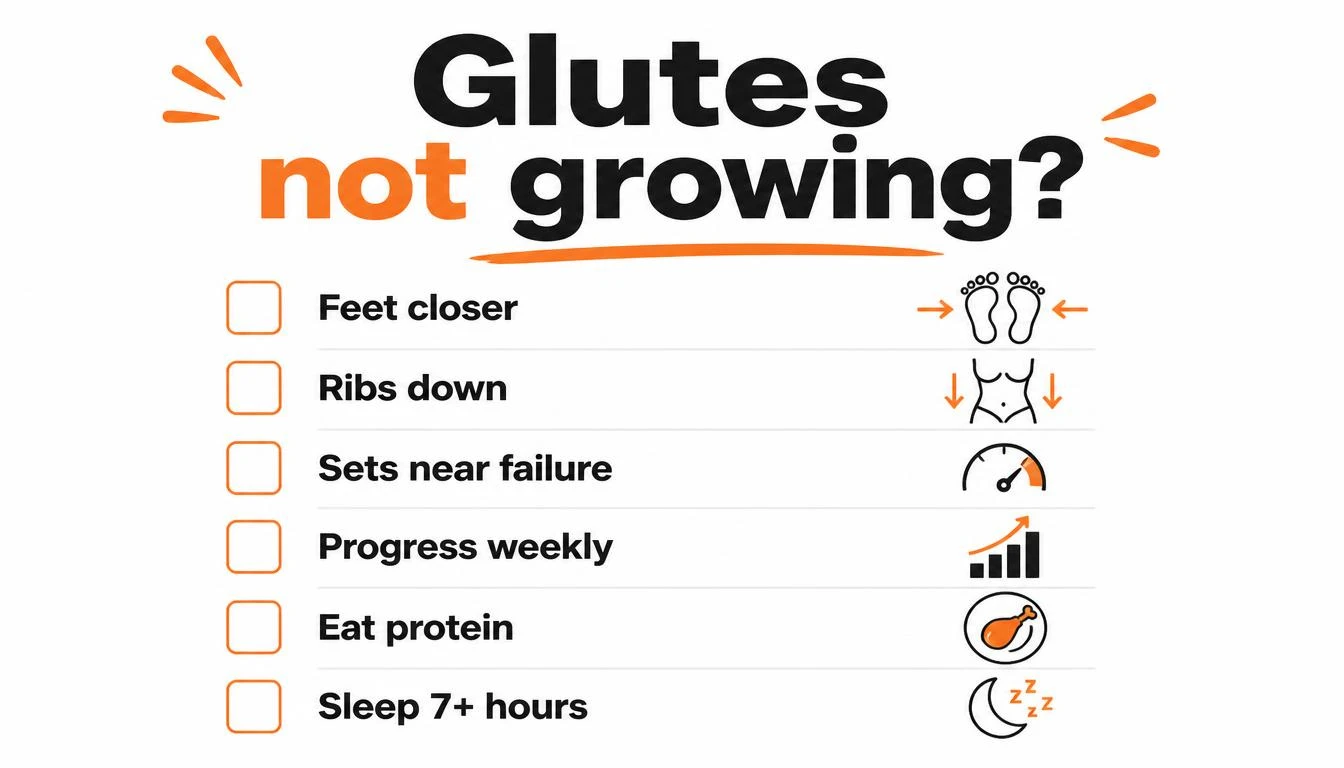
- Your quads or hamstrings are doing the work. Bring your feet closer on bridges, lean forward on lunges, and pause at the top.
- Your lower back burns. That’s arching. Ribs down, smaller range.
- You’re stopping early. Fifteen reps that left eight in the tank didn’t count.
- You’ve run the same routine for six weeks, and your body’s bored of it.
- You’re not eating enough, protein especially.
- You’re on five hours of sleep a night, which undoes more than any exercise choice can fix.
Another one people overlook is sitting for eight hours. Stiff hips cut your bridges short, so you never reach full range. Two minutes of easy hip stretching before you start, plus getting up every hour, can help more than you’d think.
Can’t tell which one’s yours? Film a set from the side. You’ll spot an arched back, a rushed lowering or half-height reps within about ten seconds. It’s a bit humbling, and it’s also the cheapest coaching you’ll ever get.
And stop treating soreness as a scoreboard. Some people never get sore and still grow. Others get wrecked by a new move and gain nothing. Track your reps and tempo instead. If this week beats last week, you’re fine.
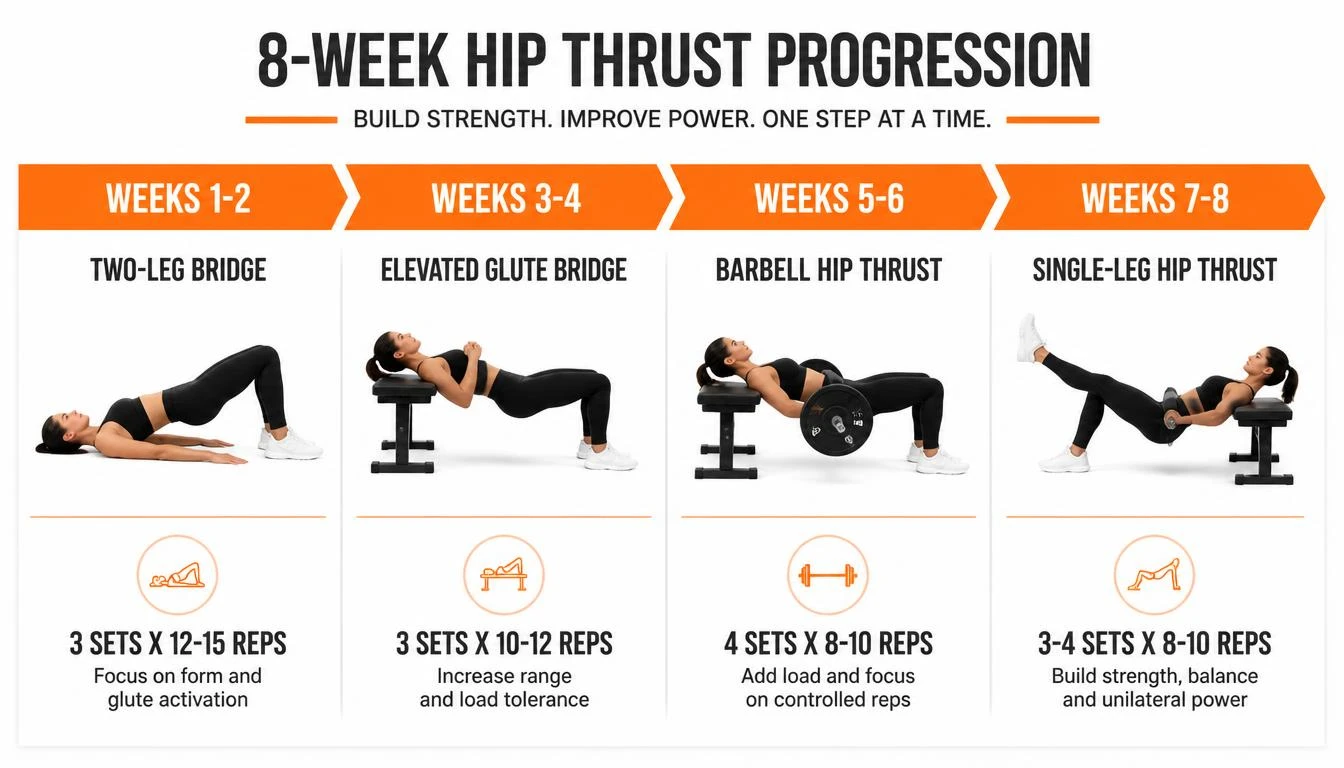
What eight weeks looks like in real numbers
Say you start with 12 clean bridges and wobbly single-leg reps. Here’s a sample run. It’s a template, not a promise, so bend it to your own numbers.
| Weeks | Hip move | Leg move | Sets x reps |
|---|---|---|---|
| 1 to 2 | Two-leg bridge, 3-second lowering | Reverse lunge | 3 x 15 bridge, 3 x 10 lunge per leg |
| 3 to 4 | Bridge with 2-second pause | Chair step-up | 3 x 20 bridge, 3 x 12 step-up per leg |
| 5 to 6 | Single-leg bridge | Reverse lunge with backpack | 3 x 10 per leg, 3 x 10 per leg |
| 7 to 8 | Single-leg hip thrust, shoulders on couch | Bulgarian split squat | 4 x 8 per leg, 3 x 8 per leg |
Notice that the move, the tempo and the load all change, not just the rep count. After week 8, go again with tougher versions, or add a resistance band for one more rung.
Quick answers
Can you do an at home glute workout with no equipment?
Yep. Bridges, lunges and step-ups all build muscle if you push the sets close to failure and keep making them harder. Use one-leg versions, slow lowering and pauses instead of weight. A chair and a backpack with some books in it will take you a long way at first.
How often should I do a glutes workout at home?
Two or three times a week is plenty for most people, with a rest day between. More days won’t speed things up, because tired glutes give you weak reps. Want more volume? Add a set or two to each session before you add another training day.
How long until I see results?
You’ll probably feel stronger around week three or four. Visible changes tend to land somewhere between weeks eight and twelve. Effort, protein, sleep and genetics all muddy the timing. Take a photo and log your reps every two weeks, because checking the mirror every morning will just make you miserable.
Are glute bridges enough on their own?
For the first few weeks, sure. After that, not really. Once 20 to 25 clean reps feels easy, switch to single-leg bridges, hip thrusts with your shoulders on a couch, and lunges. Your glutes need a challenge that keeps growing, and a plain two-leg bridge runs out of challenge fast.
Why do I feel it in my thighs or lower back?
Usually it’s setup. Move your feet closer to your hips on bridges, tuck your ribs down so you stop arching, and pause at the top. Lean your torso forward a little on lunges. If the pain is sharp or hangs around afterward, stop and see a professional.
What I’d actually do
Honestly? I’d keep it boring. Three days a week, four moves: a pause bridge, a reverse lunge, a step-up and a single-leg Romanian deadlift. Three sets each, three seconds down, every set ending with a rep or two still in the tank. Write the numbers down.
One rule on top: something gets harder every week, even by a single rep. That’s the system.
Here’s a small challenge. Tonight, film one set of single-leg bridges from the side. Film it again in four weeks. Your reps and control will show the change faster than any mirror. Bodyweight is plenty if you do a few moves hard and come back next week with a bit more.
Disclaimer. This article is for general education and isn’t medical advice. Results vary from person to person. Check with a doctor or qualified professional before starting a new exercise program, especially if you have pain, an injury, or a health condition.
Sources
- Schoenfeld BJ et al. “Strength and hypertrophy adaptations between low- vs. high-load resistance training” (2017).
- Schoenfeld BJ et al. “Dose-response relationship between weekly resistance training volume and increases in muscle mass” (2017).
- U.S. Department of Health and Human Services. Physical Activity Guidelines for Americans.
- American College of Sports Medicine. “Progression models in resistance training for healthy adults” (2009).
- Morton RW et al. “A systematic review, meta-analysis and meta-regression of the effect of protein supplementation on resistance training-induced gains in muscle mass and strength” (2018).
For more practical health and nutrition guides, visit bodylix.com

Fitness Specialist & Former Tactical Trainer
Bal Krishna Poudel has spent more than 19 years in law enforcement organization, and fitness has been at the center of it all. He knows physical conditioning, dynamic strength training, and everyday wellness inside and out. For close to two decades, he taught at official police training centers, getting officers ready for the physical demands of the job—building their endurance and operational fitness. These days, he coaches people in his local community on strength and fitness. At 49, he doesn’t just talk about staying active—he lives it, showing up every day to train and move. He writes for Bodylix, where he shares workouts and nutrition advice that regular readers can actually use, backed by science and built around one goal: helping people stay strong and healthy for the long haul.

One Response