
Desk job. Training habit. About half an hour free most evenings. Sound familiar? Here’s the short version: the best recovery tools aren’t complicated. Percussion therapy, foam rolling, a few minutes of joint mobility — done consistently, not perfectly, because perfect is where good routines go to die. Our picks: Theragun Mini if you want depth and don’t mind the price tag, Bob and Brad Q2 Mini if quiet and cheap matter more, and the TriggerPoint GRID for the foam rolling side of things. Thirty minutes a day. Setup takes about two. Keep reading — we’ll tell you the specs, and honestly, who should just skip each one.
Table of Contents
Why Recovery Gets Skipped (And Why That’s Costing You)
Here’s the thing nobody tells you when you start lifting or running seriously: the workout isn’t where the damage gets repaired. Recovery is. And for busy professionals — the ones squeezing a lift in before a 7 a.m. call or running at 9 p.m. because that’s the only gap in the calendar — recovery is almost always the first thing to go.
Our coaches at Bodylix see this constantly. Someone trains hard for six weeks, feels great, then suddenly can’t lift their arm above their head or their knee starts barking on stairs. It’s rarely the workout that did it. It’s the accumulated stiffness, the skipped mobility work, the “I’ll stretch tomorrow” that never happens.
Chronic under-recovery doesn’t just slow your gains. It’s one of the more common paths to overuse injuries — tendinopathy, muscle strains, joint irritation that lingers for months. And once you’re managing an injury instead of preventing one, you’ve lost a lot more than 30 minutes a day.
The good news: you don’t need an hour-long ritual. You need the right workout recovery equipment, used consistently, in a routine short enough that you’ll actually stick with it.
What Actually Belongs in a 30-Minute Recovery Routine?
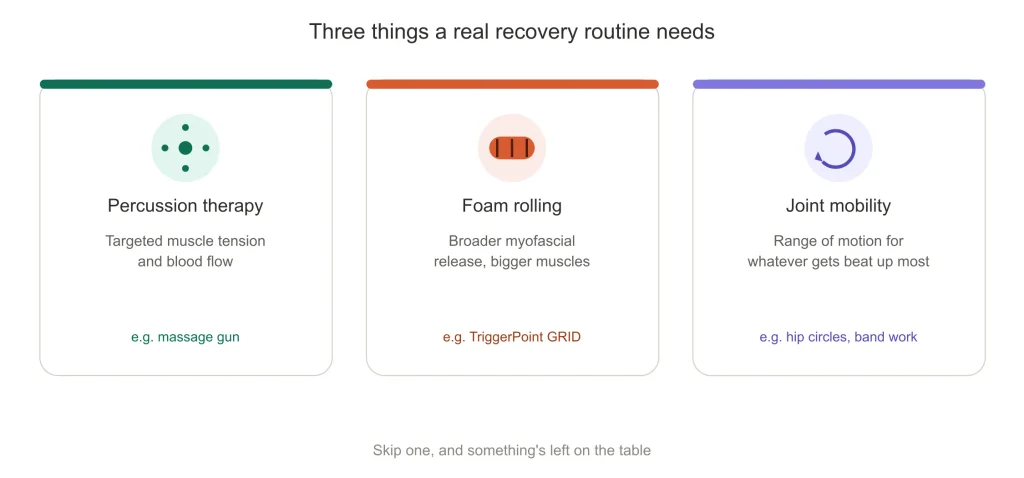
A real recovery routine — not an aspirational one you’ll do twice and abandon — needs three things working together:
- Percussive or vibration therapy for targeted muscle tension and blood flow
- Foam rolling for broader myofascial release across bigger muscle groups
- A few minutes of joint-specific mobility, especially for whatever your sport or desk job beats up most
Skip any one of these and you’re leaving something on the table. Percussion alone doesn’t address the fascia across your whole back. Foam rolling alone can’t get into the tight, specific knots a massage gun reaches. And neither one does much for joint capsule mobility, which matters more than people think if you’re over 30 and still training hard.
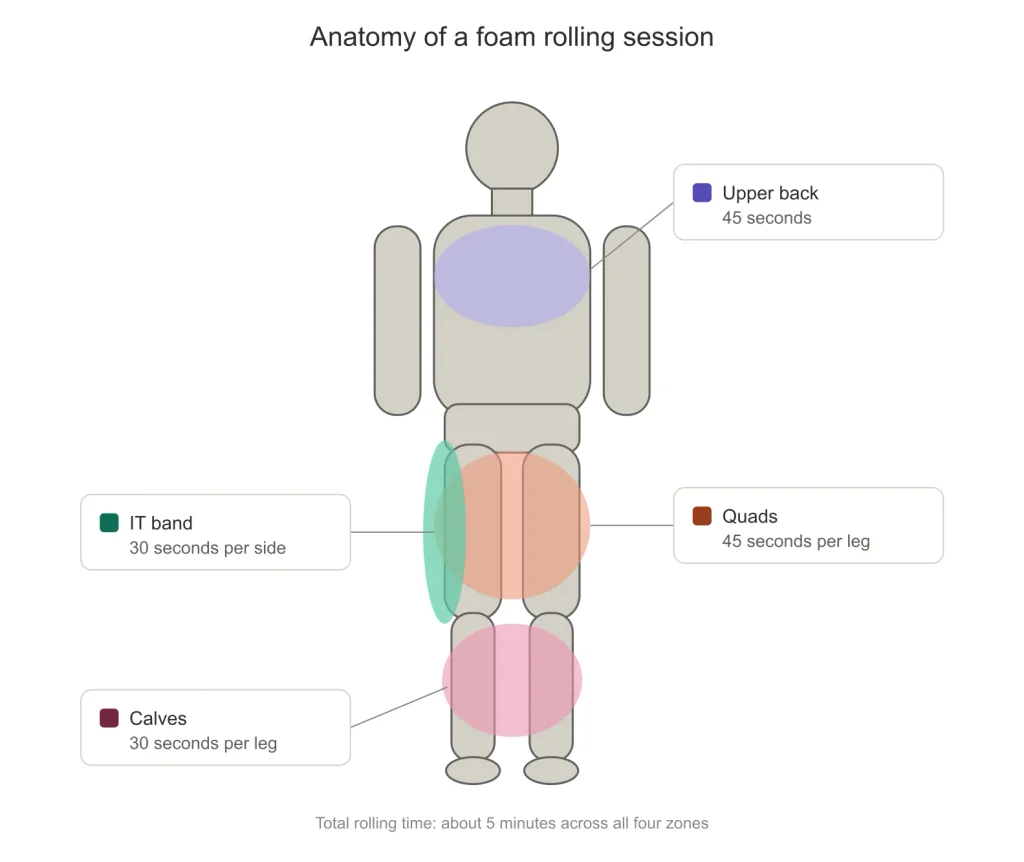
Picture this: you’ve just wrapped a 45-minute lower body session. Quads are toast, hips feel glued shut. A five-minute pass with a massage gun on the quads and glutes, three minutes rolling the IT band and calves, then two minutes of hip circles and ankle mobility — that’s ten minutes, and it covers all three bases. Do that after your two or three hardest sessions a week and you’ve built a real recovery habit without turning your evening into a second job.
Best Muscle Recovery Tools: Massage Guns Compared
Percussion massage guns are probably the single highest-leverage piece of fitness gear for fast recovery you can own right now. They’re not magic — no device replaces sleep, protein, and actual rest days — but for breaking up localized tension in ten minutes flat, nothing else comes close.
We’re comparing two here on purpose: a premium option and a genuinely solid budget one. Not every reader needs to spend $175 on a recovery tool, and honestly, we think a fair number of people are better off with the cheaper pick.
Theragun Mini (3rd Gen)
Spec Badge
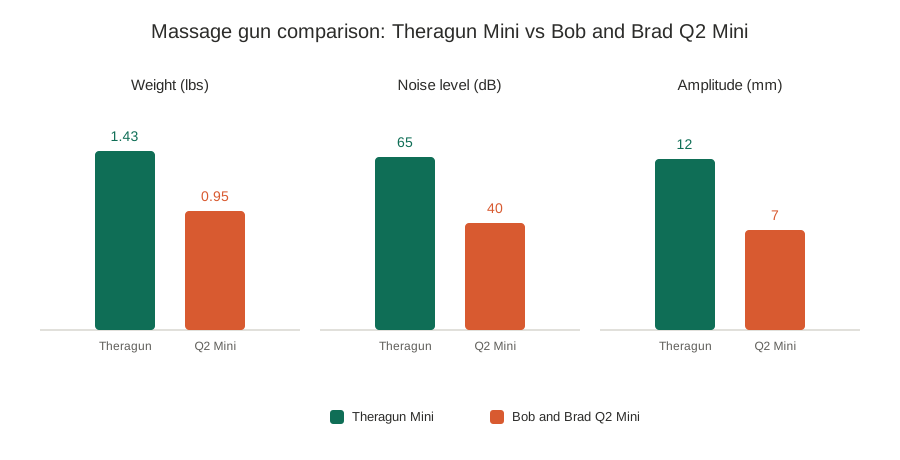
- Weight: 1.43 lbs (0.40 kg)
- Dimensions: 116mm x 135mm x 96mm (about 6″ x 5.3″ x 2.25″)
- Speed range: 1,750–2,400 percussions per minute, 3 speeds
- Amplitude: 12mm
- Noise level: measured in independent testing at roughly 57–65 decibels depending on speed and pressure — about the volume of a normal conversation on the low setting, closer to a dishwasher on the high one
- Battery life: 150 minutes per charge
- Attachments: 1 (standard ball head) on newer units, 3 on some earlier releases
- Price: around $175–$199 depending on retailer and sales
The Mini earns its reputation. Therabody’s build quality shows — it doesn’t rattle, doesn’t feel cheap, and the ergonomic triangle shape actually works even if your hands are small. The 12mm amplitude gives it real depth for something this size.
Pros & Cons
| Pros | Cons |
|---|---|
| Genuinely portable — fits in a gym bag pocket | Pricier than most minis on the market |
| Strong brand reputation and warranty support | Only one stock attachment on newer units |
| 12mm amplitude, deeper than most compact guns | Noticeably louder than budget alternatives |
| Sound insulation is decent for its motor class | Battery life is good, not class-leading |
Who It’s For: Someone who wants a name-brand tool, travels a lot, and doesn’t mind paying more for build quality and brand trust. If you already own other Theragun attachments, the Mini’s compatibility is a real perk.
Who Should Skip It: Anyone on a tighter budget, or anyone recovering in a shared space — an apartment with thin walls, an office, a partner who’s asleep next to you — where the extra 5–10 decibels versus quieter competitors will actually matter.
Check Current Price on Amazon →
Bob and Brad Q2 Mini
Spec Badge
- Weight: 0.95 lbs (0.43 kg)
- Dimensions: 5.7″ x 3.4″ x 1.8″
- Speed range: 1,800–3,000 percussions per minute, 5 speeds
- Amplitude: 7mm
- Noise level: manufacturer-rated as low as 40 decibels, with independent reviewer testing showing it running notably quieter than the Theragun Mini at comparable speeds
- Battery: USB-C fast charging, roughly 1.5–2 hours to full charge
- Attachments: 5 interchangeable heads included
- Price: typically $60–$90, frequently on sale
Designed by physical therapists, and it shows in the practical touches — five heads in the box instead of one, a genuinely quiet motor, and a stall force that punches above its size class. It won’t dig as deep as the Theragun (7mm amplitude versus 12mm), so it trades some intensity for quiet and value. For most people doing daily maintenance work rather than deep-tissue demolition, that’s a fair trade.
Pros & Cons
| Pros | Cons |
|---|---|
| Noticeably cheaper than premium competitors | Lower amplitude means less deep-tissue depth |
| Five attachments included, not one | Smaller brand, less name recognition |
| Genuinely quiet — good for shared spaces | Battery life claims vary by usage intensity |
| Lightweight, easy one-handed use | Grip shape less refined than Theragun’s |
Who It’s For: Budget-conscious buyers, people who share a home or office and need something quiet, and anyone who wants more attachment variety without spending premium-brand money.
Who Should Skip It: Athletes managing genuinely dense muscle tissue — big glutes, hamstrings, upper traps under heavy load — who need the deeper stroke length only a higher-amplitude gun delivers.
Check Current Price on Amazon →
TriggerPoint Grid 2.0 Foam Roller : The Unglamorous MVP of Joint Health
Massage guns get the flashy marketing. Foam rollers get ignored, which is a shame, because for pure joint health and injury prevention, a decent roller does something no massage gun can — it lets you apply your own bodyweight, slowly, across a big muscle group, which is a genuinely different mechanical input than percussion.
TriggerPoint Grid 2.0 Foam Roller
Spec Badge
- Dimensions: 25.98 x 5.51 x 5.51 inches
- Weight: approximately 1 pounds
- Weight capacity: rated to support up to 500 lbs of static load
- Surface: multi-density EVA foam with the patented “GRID” texture pattern — flat zones, ridges, and firm nodules
- Price: typically $74.99
There’s a reason physical therapists and trainers keep recommending this specific roller over the plain foam cylinders you’ll find for $10. The hollow-core construction holds its shape for years instead of collapsing into a soft noodle after a few months, and the textured surface actually mimics the varying pressure of a hand — flat palm, firm fingers, precise thumb — instead of just being one uniform density.
Pros & Cons
| Pros | Cons |
|---|---|
| Holds shape far longer than solid foam rollers | Firmer surface takes getting used to for beginners |
| Textured surface targets tissue more precisely | 13″ length means shorter reach for taller users |
| Hollow, so it doubles as gear storage while packed | Not adjustable — one density, take it or leave it |
| Backed by decades of physical therapy use | Pricier than basic foam alternatives |
Who It’s For: Anyone doing regular lower-body training — runners, lifters, cyclists — who wants one durable roller that handles quads, IT band, calves, and back without falling apart in six months.
Who Should Skip It: Absolute beginners to foam rolling who find firm pressure genuinely painful; a softer, lower-density roller is a more comfortable starting point before graduating to the GRID.
Check Current Price on Amazon →
Building Your Actual 30-Minute Routine
Here’s how we’d structure the full 30 minutes if you’re doing this properly, not just grabbing the massage gun for 90 seconds and calling it done.
- Minutes 0–5: Foam roll the big muscle groups. Quads, hamstrings, glutes, upper back. Slow passes, 30–45 seconds per area, pausing on tender spots for 10–15 seconds.
- Minutes 5–15: Targeted massage gun work. Hit whatever’s specifically sore — calves after a run, traps after a heavy pressing day, glutes after squats. Two minutes per muscle group, moving the gun slowly rather than jamming it in one spot.
- Minutes 15–22: Joint mobility circuit. Ankle circles, hip CARs (controlled articular rotations), shoulder dislocates with a band or towel. This is the part almost everyone skips, and it’s arguably the most important for long-term joint health.
- Minutes 22–28: Static stretching for anything still tight. Hold each stretch 30–45 seconds, breathing through it rather than fighting it.
- Minutes 28–30: Five slow breaths, lying down. Sounds like fluff. It isn’t — this is where your nervous system actually shifts out of “training mode,” and it makes a real difference in how well you sleep that night.
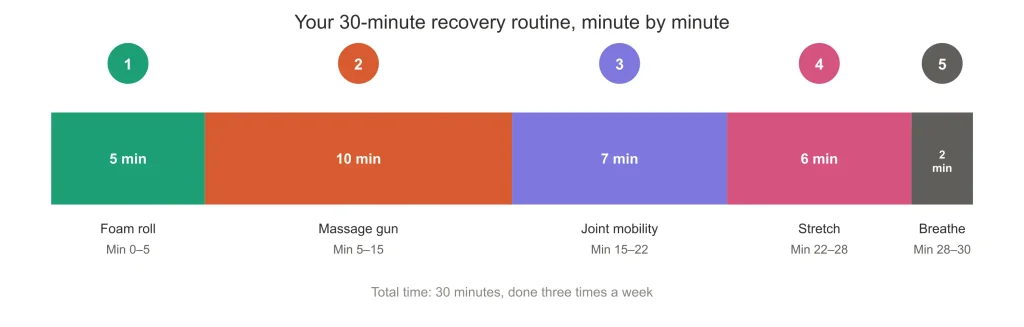
Most guides oversell how complicated this needs to be. It doesn’t. Consistency beats perfection by a wide margin here — doing this three times a week, every week, will outperform doing an elaborate 90-minute version once a month.
Fitness Gear for Fast Recovery: What to Skip
Not every piece of recovery equipment on Amazon earns its shelf space. A few honest opinions:
- Vibrating foam rollers rarely justify the price jump over a good static roller like the GRID. The vibration adds marginal benefit for a lot more cost and one more battery to charge.
- Compression boots are genuinely useful for serious endurance athletes doing high weekly mileage. For someone lifting three times a week and walking a normal amount, they’re overkill.
- Ice baths and cold plunge tubs have real research behind them for perceived soreness, but the evidence on whether they actually help long-term muscle adaptation is mixed — and for most busy professionals, the time and mess involved isn’t worth it compared to the tools above.
We’d actually skip spending on any recovery gadget until you’ve nailed sleep, protein intake, and basic mobility work. Gear amplifies a good routine. It doesn’t replace one.
FAQ
What are the best muscle recovery tools for someone with a busy schedule?
For most people juggling a full workday, the best muscle recovery tools are the ones that don’t add friction: a compact massage gun like the Theragun Mini or Bob and Brad Q2 Mini, plus a foam roller like the TriggerPoint GRID. Together they cover percussion, myofascial release, and joint mobility in about 30 minutes a day, without needing a home gym’s worth of gear.
What’s the best muscle recovery tools for beginners?
A basic foam roller and an entry-level massage gun like the Bob and Brad Q2 Mini cover most beginner needs. Start there before investing in premium gear.
How often should you use a massage gun?
Daily use on different muscle groups is fine for most people. Avoid using it directly on the same injured or acutely sore area more than once or twice a day.
Are cheaper massage guns as effective as Theragun?
For general maintenance and daily recovery, yes — budget guns like the Q2 Mini perform well. Premium guns offer deeper amplitude, which matters more for dense muscle groups and serious athletes.
How long should a foam rolling session last?
Five to ten minutes covering your major muscle groups is enough for daily maintenance. Longer sessions help after especially hard training
Can recovery tools prevent injury?
They reduce risk factors like chronic tightness and poor tissue quality, but they don’t replace proper training load management, sleep, and nutrition as the main injury-prevention levers.
What’s genuinely good fitness gear for fast recovery, versus stuff that’s just marketing?
Look for gear backed by a specific, testable claim — amplitude in millimeters, decibels at a given speed, weight capacity in pounds — not vague words like “advanced” or “professional-grade.” The fitness gear for fast recovery that actually earns its price tag in this article (the Theragun Mini, the Q2 Mini, the TriggerPoint GRID) all have real, checkable specs behind the marketing copy.
How do I know if workout recovery equipment reviews are trustworthy?
Good workout recovery equipment reviews cite actual tested numbers — noise level, amplitude, weight, price — rather than just repeating the brand’s own marketing language. If a review can’t tell you how loud something is or how it compares to a competitor on a specific spec, treat the recommendation with some skepticism.
The Bottom Line
Recovery gear doesn’t need to be complicated or expensive to actually work. A massage gun, a decent foam roller, and 30 focused minutes a few times a week will do more for your joints and muscle recovery than any elaborate routine you’ll abandon after two weeks. Start with the Bob and Brad Q2 Mini and the TriggerPoint GRID if budget matters, upgrade to the Theragun Mini if depth and brand trust matter more to you — either way, the real win is doing it consistently.
If you’ve been putting off a recovery routine because you thought it needed to be an hour-long production, this is your sign to just start with ten minutes tonight.
Disclaimer: This article is for general informational purposes and reflects editorial testing and publicly available manufacturer data. It isn’t a substitute for professional medical advice. If you’re dealing with a persistent injury or joint pain, talk to a physical therapist or doctor before starting a new recovery routine. Results vary by individual.
Reviewed by the Bodylix training team.
A quick word on how we make money: some of the links in this article are affiliate links, which means if you buy something through them, Bodylix earns a small commission — at no extra cost to you. It doesn’t change the price you pay, and it doesn’t change what we’d tell a friend. We picked the Theragun Mini, the Q2 Mini, and the TriggerPoint GRID because we’d genuinely recommend them, not because they pay the most. If a product didn’t hold up, we said so in the cons.