
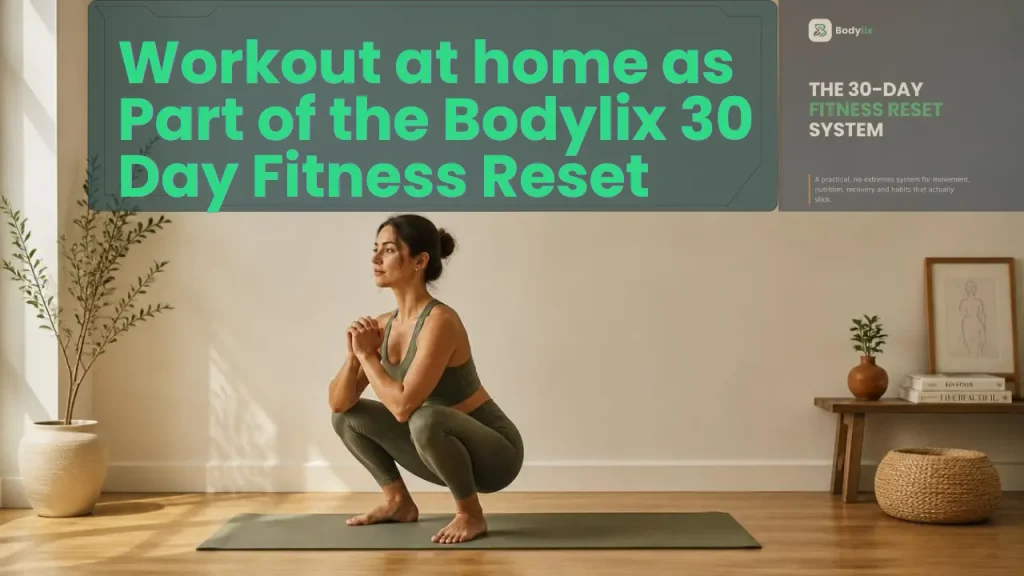
A 30 day fitness reset is a structured, month-long return to consistent training, built to break you out of a stalled routine (or no routine at all) without requiring a gym membership or a pile of equipment. Ours runs on calisthenics — pull-ups, push-ups, squats, and core work — because bodyweight training scales to any fitness level and needs nothing you don’t already own. This exact structure is what we built the Bodylix Fitness Reset Program around, and it’s the same plan we’re walking through below.
Quick note before we get into it: thirty days won’t make anything fully automatic. More on that in a second.
Table of Contents
What Is a 30 Day Fitness Reset?
Not a fat-loss challenge. Not a “shred in 30 days” gimmick, either — we’d be lying if we called it that. A fitness reset is closer to a deliberate restart: a short, defined window where you rebuild the habit of training regularly, using a plan simple enough that you don’t need to think about what to do each day.
The 30-day frame works because it’s long enough to actually feel different (strength, energy, sleep, the small stuff) and short enough that most people can commit to it without the whole thing collapsing under “life got busy.”
YOU MAY LIKE: Simple Exercises for Beginners at Home: 6 Easy Moves to Get Started
Why Calisthenics for a 30 Day Fitness Reset
We could’ve built this around dumbbells or a gym split. We didn’t, and it’s a deliberate choice, not a budget compromise.
A reset’s whole job is removing friction between you and showing up. Equipment is friction — a gym membership means a commute, dumbbells mean storage space and upfront cost, and both mean you can’t just decide at 6am to start. Calisthenics removes that. Push-ups, squats, planks, and eventually pull-ups need a floor and, in week three, a bar — nothing you have to plan around.
It also scales cleanly. A push-up on your knees and a full push-up work the same muscles at different difficulty levels, so the same 30 day calisthenics workout plan fits someone who’s never trained and someone getting back into it after a long break. You just start at a different point on the same movement.
Does 30 Days Actually Change Anything?
Here’s the honest part most fitness content skips. The often-repeated “21 days to build a habit” line isn’t from a habit study at all — it traces back to a 1960s book about how plastic surgery patients adjusted to a new appearance, not behavior change. The real research on habit formation, a 2010 study out of University College London, found something messier: the median time to make a daily behavior feel automatic was 66 days, with a huge range depending on the person and the behavior — anywhere from about 18 to 254 days.
So no, a 30 day fitness reset won’t make training feel fully automatic. What it will do is get you through the hardest, least-motivated stretch — the first few weeks where everything feels effortful — and hand you a body that’s stronger and a routine that’s roughly a third of the way toward sticking on its own. That’s a real result. It’s just not the “brand new you in a month” pitch you’ll see everywhere else.
Inside the Bodylix Fitness Reset Program
We built the Bodylix Fitness Reset Program around exactly the structure in this article, but packaged with the pieces that are genuinely hard to build yourself on day one: daily workout videos so you’re never guessing at form, a week-by-week progression that adjusts as you get stronger, a private check-in group for accountability, and a basic nutrition framework that doesn’t require counting a single macro.
None of that is required to run a 30 day fitness reset — everything below works fine on your own, with a notebook and a bit of trial and error. The program just compresses the trial-and-error part. If that’s appealing, the full program details are here.
Your 30 Day Calisthenics Workout Plan, Week by Week

Week 1 — Foundation. Three sessions, 20–25 minutes each. Bodyweight squats (3 sets of 12), incline or knee push-ups (3 sets of 8–10), dead hangs (3 rounds, hold as long as you can), and planks (3 sets of 20–30 seconds). The goal isn’t intensity. It’s showing up and locking in form before you add load or volume.
Week 2 — Volume. Four sessions. Standard push-ups (3–4 sets of 10–12) replace incline versions for most people by now. Add negative pull-ups (3 sets of 3–5), step up plank holds to 45 seconds, and introduce glute bridges (3 sets of 15). Rep counts climb roughly 20–30% from week one, and squats move up to 3–4 sets of 15.
Week 3 — Progression. Still four sessions, but harder variations enter: assisted or full pull-ups (3–4 sets of 4–8) depending on where you landed in week two, dips if you’ve got access to a bar or sturdy chairs (3 sets of 6–10), and Bulgarian split squats (3 sets of 10 per leg). This is usually the week people feel the biggest jump in capability.
Week 4 — Test and lock in. Retest your week-one baseline — how many push-ups in one set, how long a plank hold, whether that first pull-up showed up. Then build your ongoing weekly split from whatever felt best across the month. The reset ends; the training doesn’t have to.
Nutrition During Your Reset

We’re not going to hand you a meal plan or a calorie target here — that’s a longer conversation than a fitness reset article should try to cram in, and a rigid number rarely survives contact with real life anyway. What actually matters during these 30 days: eat something with protein at each meal, drink enough water that you’re not confusing thirst for hunger, and don’t try to overhaul your entire diet in the same week you overhaul your training. One big change at a time sticks. Two at once usually means neither does.
What a Normal Day Looks Like
Five minutes of mobility and light cardio to warm up. Fifteen to twenty minutes of the day’s circuit, moving through exercises with short rest between rounds. A couple of minutes of stretching to close it out. Most days of the 30 day fitness reset run 25–30 minutes total, which is short enough that “I don’t have time” stops being a real excuse by about day four.
Mistakes That Derail a Reset
Most resets don’t die in week three. They die in the first two weeks, before momentum even shows up. Going too hard on day one is usually the culprit. People treat their first session like an audition instead of the start of a month — max effort, no pacing — and end up too sore to move by day three. That’s it. Reset over, before it really started.
Skipping rest days is a close second. Recovery is where the actual adaptation happens, not the workout itself, and cramming in extra sessions “to catch up” usually backfires.
And then there’s the all-or-nothing trap: missing one day and treating the whole reset as blown. It isn’t. The habit research above is clear on this — missing a single day didn’t break people’s progress toward automaticity. Miss a day, pick it back up tomorrow, keep going.
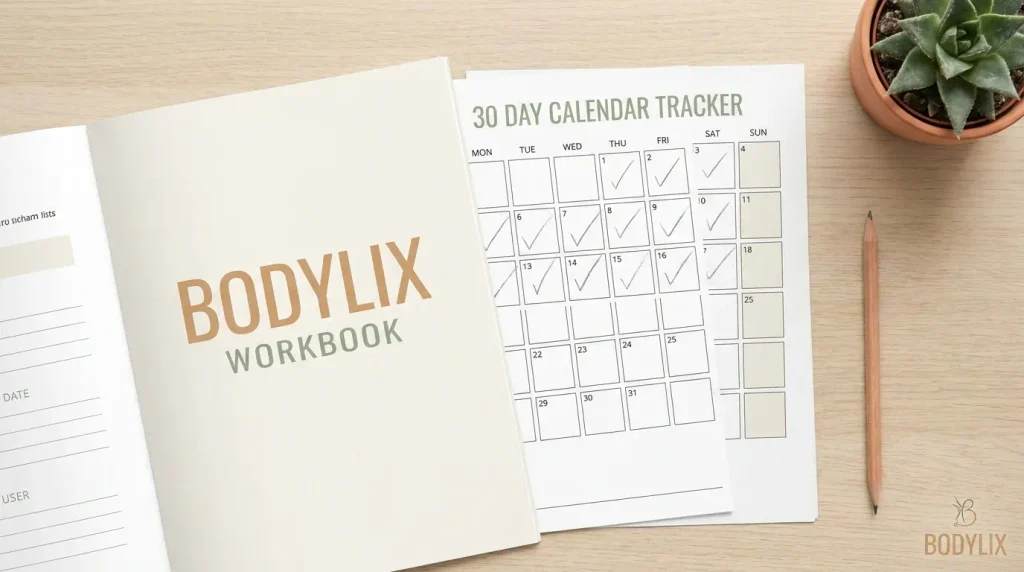
One more, easy to miss: doing the reset with no way to track what happened. Without writing down reps, sets, or how a session felt, week four’s “test and lock in” step doesn’t mean much — you’re comparing to a memory instead of a number. A notebook, a notes app, or the tracking built into the Bodylix Fitness Reset Program all solve this the same way.
DIY vs. the Bodylix Fitness Reset Program
Running this yourself works. Print the week-by-week breakdown above, follow it, adjust reps as things get easier. Plenty of people do exactly that and get real results.
Where people usually get stuck doing it solo is form (nobody’s checking whether that push-up actually counts), progression (guessing when to add difficulty instead of following a tested curve), and accountability (day 12 is where most solo attempts quietly die). The Bodylix Fitness Reset Program exists specifically to remove those three friction points — video demonstrations for every movement, a progression that’s already been tested on real people instead of guessed at, and a group of people doing the same reset at the same time. Worth a look at the program page if any of those three have been what’s derailed you before.
FAQ
What is the Bodylix Fitness Reset Program? It’s Bodylix’s structured 30-day calisthenics program — daily workout instrutions, a tested week-by-week progression, a nutrition framework, and an accountability group, built around the same plan outlined in this article.
Can beginners do a 30 day fitness reset? Yes. Week one is intentionally light — bodyweight squats, incline push-ups, dead hangs — specifically so beginners aren’t thrown into advanced movements before their body’s ready for them.
Do I need equipment for the 30 day calisthenics workout plan? No equipment is required, though access to a pull-up bar in week three opens up a couple of extra progressions. Everything else uses just bodyweight and floor space.
Is 30 days actually enough to see results? Enough to see real strength gains, better movement quality, and more consistent energy — yes. Enough to make training fully automatic long-term — no, and we’d rather tell you that upfront than oversell it.
What happens after the 30 days end? Week four is built around figuring out a sustainable ongoing split based on what worked for you. Many people in the Bodylix Fitness Reset Program roll straight into our follow-on programming, but the plan works as a standalone reset too.
How is the Bodylix Fitness Reset Program different from just following this article for free? This article gives you the real structure — nothing here is held back. The program adds the parts that are hard to replicate solo: form-checked video demos, a group hitting the same milestones as you in real time, and a progression that adjusts automatically if a week feels too easy or too hard, instead of you guessing.
Start Where You Are
A 30 day fitness reset isn’t a transformation photo waiting to happen. It’s thirty days of showing up to something simple enough that skipping it takes more effort than doing it. That’s the actual win — not the six-pack, the consistency underneath it.
If you’d rather not build the spreadsheet and guess at progressions yourself, the Bodylix Fitness Reset Program has the whole thing built out already — daily videos, week-by-week structure, and a group starting alongside you. Either way: pick a start date this week, not “eventually.”
Quick disclaimer: this is general fitness info, not medical advice tailored to you. Got an injury, a health condition, or you’re just not sure your body’s ready for this? Talk to a doctor first. Better to ask than to find out the hard way.
ALSO READ: Building a Home Gym Setup That Actually Fits Your Life

Fitness Specialist & Former Tactical Trainer
Bal Krishna Poudel has spent more than 19 years in law enforcement organization, and fitness has been at the center of it all. He knows physical conditioning, dynamic strength training, and everyday wellness inside and out. For close to two decades, he taught at official police training centers, getting officers ready for the physical demands of the job—building their endurance and operational fitness. These days, he coaches people in his local community on strength and fitness. At 49, he doesn’t just talk about staying active—he lives it, showing up every day to train and move. He writes for Bodylix, where he shares workouts and nutrition advice that regular readers can actually use, backed by science and built around one goal: helping people stay strong and healthy for the long haul.

khiqWemFFEDnCUTIbSQdMZ