
A power tower workout can build a stronger back, chest, shoulders, and core than most home gym setups twice its price — and you don’t need a single dumbbell to do it. If you’ve got a power tower (that A-frame rig with a pull-up bar, dip handles, and usually a padded back support for knee raises) sitting in your garage or spare room, this is everything you need to actually use it well.
We get asked about this piece of equipment constantly at Bodylix. It’s cheap, it doesn’t need a power outlet, and in a country where gym memberships aren’t always practical and monsoon season makes outdoor training a coin flip, a home gym power tower earns its keep fast. Think of it as a pull up dip station routine you never have to book, queue for, or drive to.
Table of Contents
- What Is a Power Tower, Exactly?
- Why a Power Tower Workout Actually Works
- Muscles a Power Tower Workout Targets
- The Core Power Tower Exercises
- A Power Tower Workout for Beginners
- Intermediate and Advanced Power Tower Workout Routines
- Common Mistakes People Make
- Power Tower vs. the Gym — Which Wins?
- FAQ
What Is a Power Tower, Exactly?
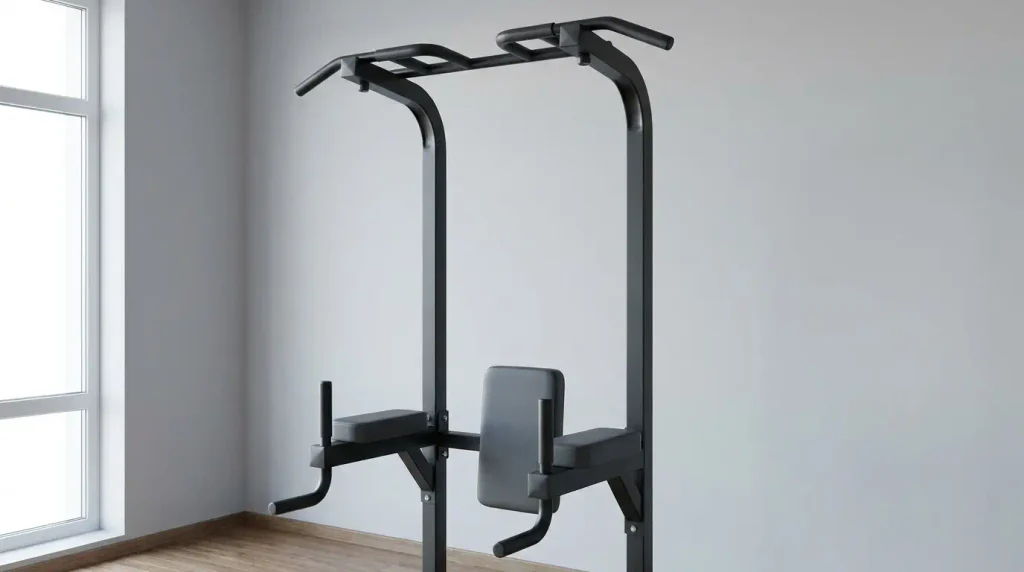
A power tower is a freestanding, all-in-one strength rig. Most models combine three stations: a pull-up bar up top, vertical dip handles on the sides, and a padded knee-raise station at the base. Some throw in push-up handles too.
A budget-friendly example a lot of home gyms run is the Weider Power Tower, which covers all four stations without eating up much floor space.
That’s it. That’s the whole machine.
No cables, no weight stack, no motor. Just steel and your bodyweight. Which, if you’ve ever tried a strict pull-up, you already know is plenty.
You may also like : Simple Exercises for Beginners at Home: 6 Easy Moves to Get Started
Why a Power Tower Workout Actually Works
Bodyweight training gets dismissed sometimes as the “easy” option compared to barbells. It isn’t. A well-built power tower workout hits pulling, pushing, and core work in one station, and progression comes from adding reps, slowing tempo, or adding a weighted vest — not from stacking plates you might not own.
The CDC’s physical activity guidelines call for muscle-strengthening work covering all major muscle groups at least twice a week, on top of 150 minutes of moderate aerobic activity. A power tower workout can knock out that strength-training requirement in under 30 minutes. You don’t need six machines to hit that bar. You need one tower and a plan.
Here’s the honest trade-off, though: a power tower workout won’t build raw maximal strength the way a heavy barbell squat or deadlift will. If your goal is a bigger one-rep max on the big lifts, this isn’t your primary tool. If your goal is a strong, capable upper body and a core that actually holds up under load — this is one of the most efficient pieces of equipment you can own.
Muscles a Power Tower Workout Targets
- Back and lats — pull-ups and chin-ups are the backbone of any power tower workout, and nothing else on the rig comes close for lat development
- Shoulders get worked from two directions: pulling movements hit the rear delts, dips hammer the front
- Chest and triceps — dips, plain and simple
- Core, specifically the lower abs and hip flexors, via hanging knee raises and leg raises
- Grip strength, almost as a side effect. Hang from a bar for 45 seconds and you’ll feel it
The Core Power Tower Exercises
Every solid power tower workout is built from a small handful of moves. Master these before you go chasing variations.
Pull-ups. Overhand grip, hands just outside shoulder width. Chin clears the bar, arms fully extend at the bottom. If you can’t do one yet — most people can’t at first, and that’s fine — start with dead hangs and negatives (jump to the top, lower as slowly as you can).
Chin-ups. Underhand grip. Easier than pull-ups for most people because the biceps help more. A good entry point if strict pull-ups feel impossible right now.
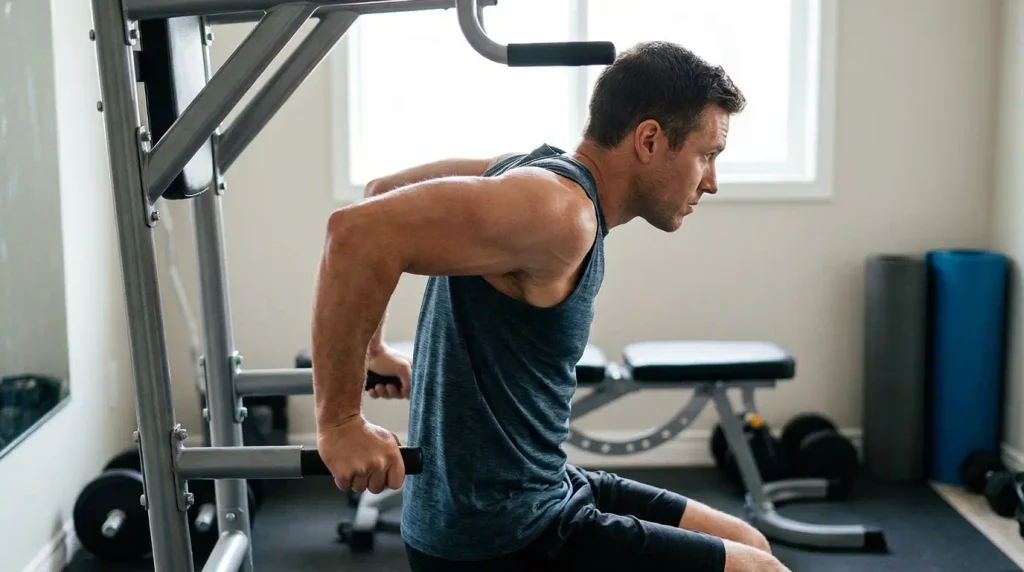
Dips. Grip the handles, lean forward slightly, lower until your shoulders dip below your elbows, press back up. Lean forward more to bias chest, stay upright to bias triceps.
Hanging knee raises. Hang from the bar or use the padded arm supports, knees drive up toward your chest, control the descent. Don’t swing — momentum is doing the work you’re trying to avoid.
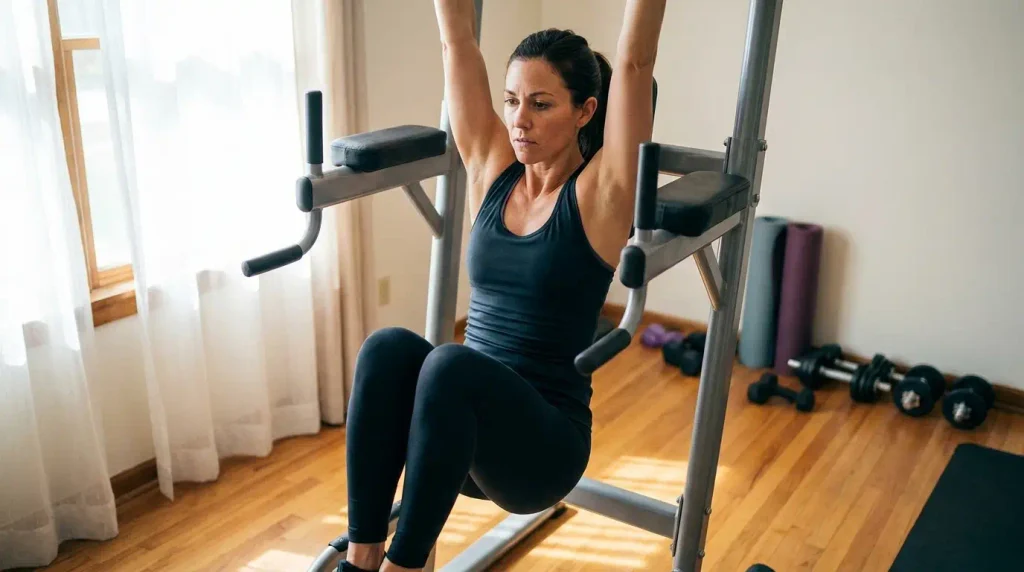
Leg raises. Same setup, straight legs instead of bent knees. Considerably harder. Save this one for when knee raises feel easy for 15+ reps.
Push-ups (if your tower has handles). Standard bodyweight push-up, just elevated slightly, which adds a bit of range of motion at the bottom.
A Power Tower Workout for Beginners
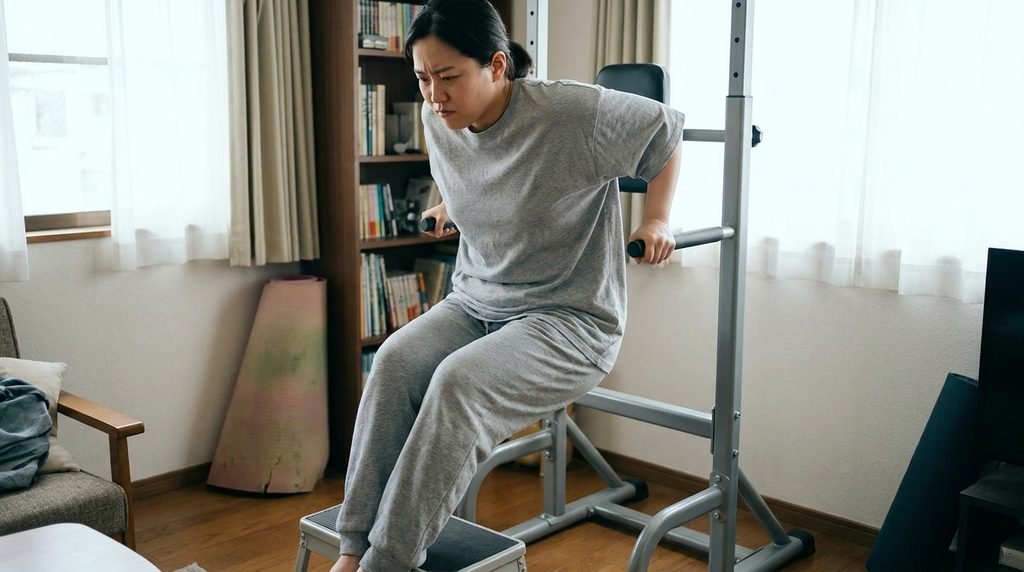
Twice a week, non-consecutive days. Rest 60–90 seconds between sets.
- Dead hangs: 3 sets, hold as long as you can
- Negative pull-ups: 3 sets of 3–5
- Assisted or bench dips: 3 sets of 8–10
- Hanging knee raises: 3 sets of 8–10
- Push-ups: 3 sets of 10–15
Give this four to six weeks before adding volume. Strength here builds slower than most people expect, and that’s normal — tendons and connective tissue adapt on a longer timeline than muscle does.
Intermediate and Advanced Power Tower Workout Routines
Intermediate (can do 5+ strict pull-ups):
- Pull-ups: 4 sets of 6–8
- Chin-ups: 3 sets of 8–10
- Dips: 4 sets of 10–12
- Leg raises: 3 sets of 10
- Push-ups: 3 sets of 15–20
Run this three times a week. Add a weighted vest or a backpack loaded with books once bodyweight reps stop feeling hard.
Advanced:
- Weighted pull-ups: 5 sets of 5
- Weighted dips: 4 sets of 6–8
- Archer pull-ups or one-arm negatives: 3 sets of 3–5 per side
- Toes-to-bar: 4 sets of 8
- L-sit holds on the dip handles: 4 sets, max hold
This is where a power tower workout starts to look genuinely impressive, and honestly, most people never train long enough to get here. That’s not a knock — it’s just true.
Choosing a Home Gym Power Tower
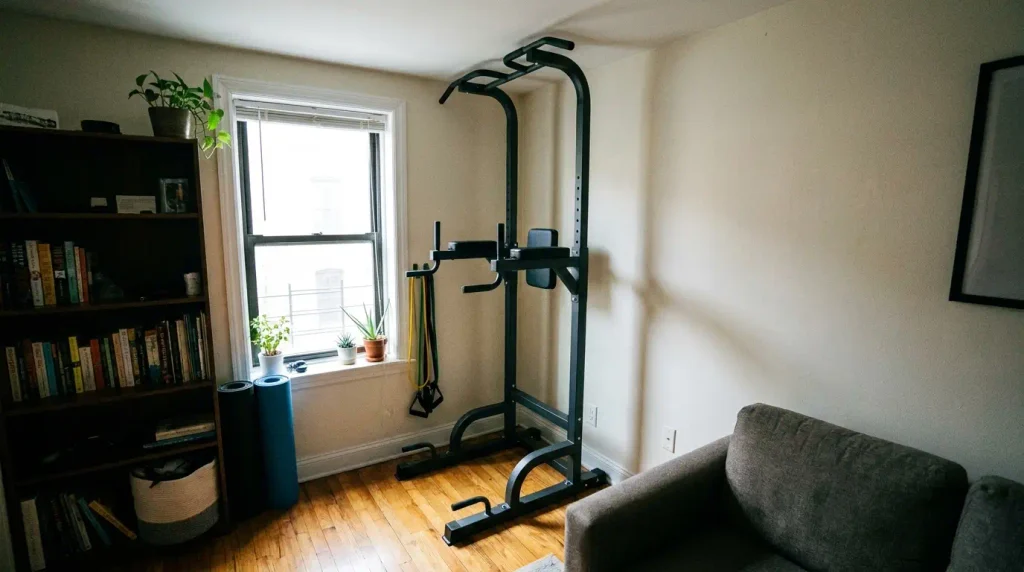
Not every rig is built the same, and this is where people either get a decade of use out of one machine or end up with a wobbly frame gathering dust in six months.
A few things worth checking before you buy:
- Height and clearance. Measure your ceiling. A lot of buyers skip this and end up with a tower that clips the fan or the ceiling on every rep.
- Weight capacity should have real headroom above your bodyweight — look for at least 130kg rated capacity even if you’re nowhere near that, because added weight vests and dynamic movements load the frame harder than a static hang.
- Footprint stability. Wider bases resist tipping during dips far better than narrow ones. If you can rock the frame side to side in the showroom, skip it.
- Padding on the knee-raise arms and backrest matters more than people expect — cheap foam wears through fast and starts digging into your forearms mid-set.
- Adjustability. Some models let you shift the dip handle width or the bar height. Not essential, but genuinely nice if more than one person in the house uses it.
Most decent home gym power tower units run somewhere in the mid-range price bracket locally — not the cheapest option in the shop, but nowhere near what a set of adjustable dumbbells or a squat rack would cost. For the amount of training it unlocks, it’s one of the better cost-per-workout pieces of kit you’ll own.
If you want a step up with a padded captain’s chair and a slightly sturdier X-frame, the Sunny Health & Fitness Power Tower is worth a look — it’s a common recommendation in home-gym reviews for exactly the stability reasons above. And if barbell storage matters because your space doubles as a small home gym, this adjustable power tower with a built-in dumbbell holder folds that in without adding much bulk.
Common Mistakes People Make
Rushing the pull-up progression is probably the biggest one. Kipping and swinging to fake reps builds bad habits and does almost nothing for actual back strength. Slow down and own the movement.
Skipping the core station is another. Plenty of people treat the tower as a pull-up bar with a bonus dip attachment and ignore the knee-raise pad entirely. That’s half the equipment going unused.
And then there’s overtraining the push side. Dips and push-ups feel satisfying to bang out, so people do them constantly and neglect pulling work — which leaves you with rounded shoulders and a back that lags behind. Aim for roughly equal pulling and pushing volume across the week.
One more, smaller thing: check your tower’s stability before you load it up. A wobbly frame on an uneven floor is how a good workout turns into a trip to the clinic.
Power Tower vs. the Gym — Which Wins?
Depends what you’re after. A commercial gym gives you barbells, machines, and a wider ceiling for strength progression long-term. A power tower workout gives you zero commute, zero membership fee, and total flexibility — you can train at 6am before the Kathmandu traffic wakes up, or squeeze in a session during a power cut when the gym’s generator hasn’t kicked in yet.
For a lot of Bodylix readers, it’s not really either/or. A power tower at home covers the days you can’t make it to a gym, and it’s often the thing that keeps a program alive during exam weeks, monsoon flooding, or whatever else gets in the way.
Can’t find a suitable wall or door frame for a mounted pull-up bar? A freestanding power tower solves that on its own — which is really the whole pitch for anyone in a rented room or a small apartment.
FAQ
Is a power tower workout enough to build muscle on its own? Yes, for your upper body and core — pull-ups, dips, and leg raises can build real size and strength using progressive overload through reps, tempo, or added weight. It won’t replace leg training, though, so pair it with squats, lunges, or running for a balanced program.
How often should I do a power tower workout each week? Two to three times a week works for most people, with at least one rest day between sessions. Beginners should stick closer to two; once recovery is solid, three sessions a week speeds up progress noticeably.
What if I can’t do a single pull-up yet? Completely normal, especially for beginners. Start with dead hangs and slow negatives — jump to the top position and lower yourself as slowly as possible. Most people see their first strict pull-up within six to ten weeks of consistent practice.
Can a power tower workout help with weight loss? It builds muscle, which raises your resting metabolic rate over time, but it’s not a high-calorie-burn cardio session on its own. Pair it with walking, running, or cycling and a reasonable diet if fat loss is the main goal.
Do I need a power tower, or will a doorway pull-up bar do? A doorway bar covers pull-ups and chin-ups only. A power tower adds dips and knee raises in the same footprint, which is a meaningfully more complete workout for roughly the same price.
What are the best power tower ab exercises if hanging leg raises feel too hard? Start with knee raises instead of straight-leg raises — same station, much less hip-flexor demand. If even those feel too advanced, try flutter kicks while seated on the dip handles, or simply hold a bent-knee tuck position for time. Progress to full leg raises once knee raises feel easy for 15 reps.
The Bottom Line
A power tower isn’t flashy. It’s a frame, a bar, and two handles, and it’ll outlast most of the fancier equipment people buy and stop using within a year. Give it two months of consistent training — dead hangs to full pull-ups, assisted dips to weighted dips — and you’ll have a stronger back and a more capable body than half the people paying for a gym membership they use twice a month.
Start with the beginner routine above this week. Don’t skip to advanced because it looks more interesting — the boring version is the one that actually works.
This article is for general fitness information and isn’t a substitute for individualized medical or training advice. If you have an existing injury or health condition, check with a doctor or qualified trainer before starting a new strength program.
Disclosure: Bodylix is a participant in the Amazon Associates program. Some links above are affiliate links, and we may earn a small commission on qualifying purchases at no extra cost to you.
Read Also: 10-Minute Full Body Workout for Beginners (No Equipment Needed)

Fitness Specialist & Former Tactical Trainer
Bal Krishna Poudel has spent more than 19 years in law enforcement organization, and fitness has been at the center of it all. He knows physical conditioning, dynamic strength training, and everyday wellness inside and out. For close to two decades, he taught at official police training centers, getting officers ready for the physical demands of the job—building their endurance and operational fitness. These days, he coaches people in his local community on strength and fitness. At 49, he doesn’t just talk about staying active—he lives it, showing up every day to train and move. He writes for Bodylix, where he shares workouts and nutrition advice that regular readers can actually use, backed by science and built around one goal: helping people stay strong and healthy for the long haul.
