
If you’ve ever looked around your living room and wondered how to strengthen your back without a single dumbbell, band, or pull-up bar, you’re not alone. Many people start their fitness journey at home, dealing with limited space, busy schedules, or simply not wanting to invest in gear yet. The good news is that solid back exercises at home without equipment exist. They can improve posture, build muscular endurance, and help you feel more stable in daily life. This guide walks you through a complete no-equipment approach designed for beginners. You’ll get clear instructions, realistic expectations, two ready-to-use routines, and practical tips so you can start today and keep progressing safely.
Also like to read: 10 Best Home Workouts for Beginners You Can Do Without Equipment
Table of Contents
Can You Train Your Back Exercises At Home Without Equipment?
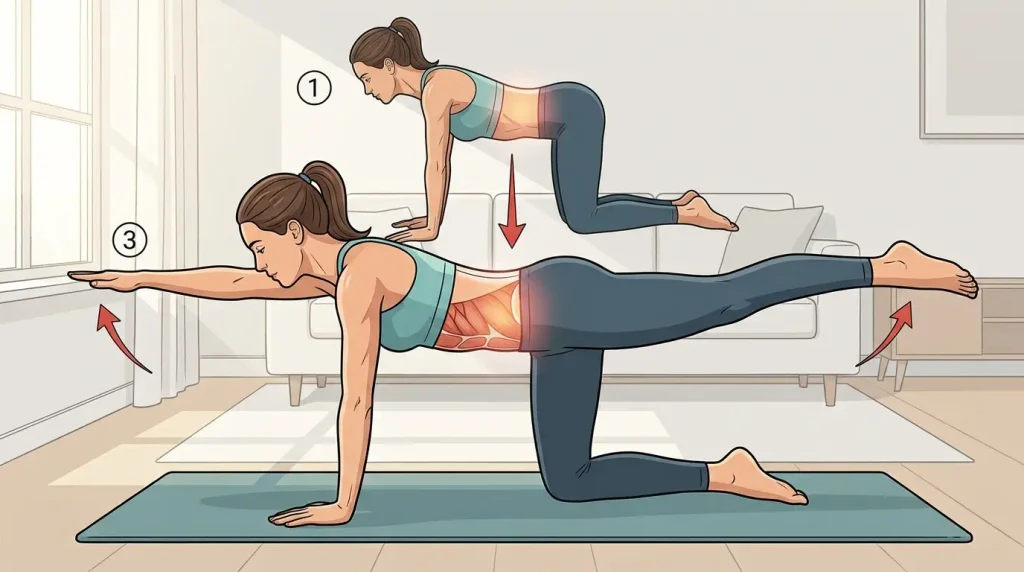
Yes. Your back responds to tension, control, and consistent effort. Bodyweight exercises create that tension through gravity, leverage, and precise movement. Moves that lift your arms or torso against gravity challenge the rear shoulders, upper back, and spinal stabilizers. Floor-based patterns teach the lower back and core to work together.
Over time these exercises for back strength improve how your muscles fire and how you hold yourself during everyday tasks. You won’t replicate the exact loading of heavy rows or weighted pull-ups, but you can still make meaningful progress in control, endurance, and posture support.
What This Workout Can and Cannot Do
Back exercises at home without equipment shines at building muscular endurance, improving scapular control, strengthening the spinal erectors, and reinforcing better posture. It also teaches you how to engage the right muscles so future training (with or without gear) feels more effective. Limitations exist. True pulling strength and significant muscle size (hypertrophy) are harder to develop without external resistance. Horizontal and vertical pulling patterns are difficult to load heavily using only bodyweight on the floor. These bodyweight back exercises prioritize quality of movement and endurance over maximal strength or rapid size gains. Think of this work as foundation-building. It prepares your back for better performance in daily life and future progressions.
Warm-Up
Spend 5–7 minutes preparing your body before any back workout at home.
- March in place or walk around the room for 60–90 seconds.
- Arm circles forward and backward, 10 each direction.
- Cat-cow stretches on all fours, 8–10 slow reps.
- Gentle thoracic rotations while seated or standing, 5 each side.
- Shoulder blade squeezes, 10 controlled reps.
Move smoothly. The goal is to increase blood flow and wake up the muscles you’ll use, not to fatigue them.
Complete Back Exercises at Home Without Equipment
Here are effective options that target different areas of the back. Perform them on a comfortable surface such as a mat or carpet.
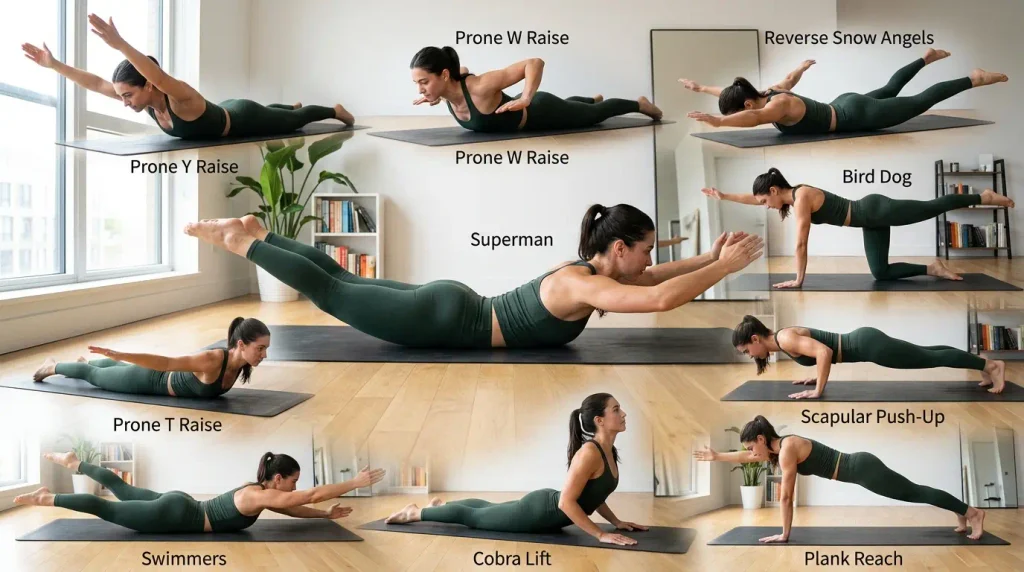
1. Prone Y Raises
Main muscles worked: Upper back, rear shoulders, lower traps.
Lie face-down with arms extended overhead in a Y shape, thumbs up. Lift arms a few inches while keeping neck neutral. Lower with control.
Sets/reps: 2–3 sets of 8–12.
Beginner modification: Lift only one arm at a time or reduce range.
Common mistakes: Lifting the head or arching the lower back excessively.
Cue: Exhale as you lift; keep the movement small and precise.
2. Prone W Raises
Main muscles worked: Mid-back, rear delts, rhomboids.
Lie face-down, bend elbows so arms form a W, thumbs pointing up. Squeeze shoulder blades and lift arms slightly. Lower slowly.
Sets/reps: 2–3 sets of 10–12.
Beginner modification: Smaller lift or shorter hold.
Common mistakes: Shrugging shoulders toward ears.
Cue: Imagine sliding your shoulder blades down and together.
3. Reverse Snow Angels
Main muscles worked: Entire upper and mid-back, rear shoulders.
Lie face-down, arms at sides. Sweep arms out and up overhead in a wide arc while keeping them just off the floor, then reverse.
Sets/reps: 2–3 sets of 8–10 slow reps.
Beginner modification: Shorter arc or rest hands lightly on the floor between reps.
Common mistakes: Rushing or lifting the chest high.
Cue: Keep continuous light tension; breathe steadily.
4. Swimmers
Main muscles worked: Upper back, lower back, rear shoulders.
Lie face-down. Lift opposite arm and leg slightly, then switch in a swimming motion.
Sets/reps: 2–3 sets of 20–30 seconds or 10 switches per side.
Beginner modification: Lift only arms or only legs.
Common mistakes: Holding the breath or twisting the torso.
Cue: Move from the mid-back; keep hips steady.
5. Bird Dogs
Main muscles worked: Lower back, core, glutes, mid-back stabilizers.
Start on all fours. Extend one arm forward and the opposite leg back while keeping hips level. Hold briefly, return, switch sides.
Sets/reps: 2–3 sets of 8–10 per side.
Beginner modification: Extend only the arm or only the leg.
Common mistakes: Letting the lower back sag or hiking the hip.
Cue: Brace your midsection as if preparing for a light poke.
6. Supermans
Main muscles worked: Lower back, glutes, upper back.
Lie face-down, arms extended. Lift arms, chest, and legs a few inches. Hold briefly, lower.
Sets/reps: 2–3 sets of 8–12.
Beginner modification: Lift only the upper body or only the legs.
Common mistakes: Looking up or overextending the neck.
Cue: Keep the gaze toward the floor; lift with control.
7. Cobra Lifts (gentle)
Main muscles worked: Lower back, spinal erectors.
Lie face-down, hands under shoulders. Press lightly to lift the chest while keeping hips down. Lower slowly.
Sets/reps: 2–3 sets of 8–10.
Beginner modification: Smaller lift or support more weight on the forearms.
Common mistakes: Pushing too high or forcing the lower back.
Cue: Lengthen through the spine rather than cranking upward.
8. Scapular Push-Ups
Main muscles worked: Serratus, mid-back stabilizers, posture muscles.
In a high plank or on knees, keep arms straight and let the shoulder blades come together, then push them apart.
Sets/reps: 2–3 sets of 8–12.
Beginner modification: Perform against a wall or on an elevated surface.
Common mistakes: Bending the elbows or dropping the hips.
Cue: Move only the shoulder blades; body stays rigid.
9. Plank Reaches
Main muscles worked: Core, shoulders, upper back stabilizers.
Hold a plank (or modified on knees). Reach one arm forward slowly, return, switch.
Sets/reps: 2–3 sets of 6–8 per side.
Beginner modification: Wider base or shorter reach.
Common mistakes: Rotating the hips.
Cue: Squeeze the glutes and brace before reaching.
10. Prone T Raises
Main muscles worked: Mid-back, rear delts.
Lie face-down, arms out to the sides in a T. Lift arms while squeezing the shoulder blades.
Sets/reps: 2–3 sets of 10–12.
Beginner modification: Smaller range.
Common mistakes: Bending the elbows.
Cue: Lead with the pinkies or thumbs pointing up.These upper back exercises at home and lower back exercises at home work together to support better posture and everyday strength.
Beginner No-Equipment Back Workout
Perform this beginner back workout 2–3 times per week. Rest 45–60 seconds between sets.
- Bird Dogs – 2 sets of 8 per side
- Prone Y Raises – 2 sets of 8–10
- Scapular Push-Ups – 2 sets of 8
- Supermans (modified if needed) – 2 sets of 8
- Prone W Raises – 2 sets of 10
- Gentle Cobra Lifts – 2 sets of 8
Total time: about 15–20 minutes. Focus on form over speed.
More Challenging back exercises at home without equipment
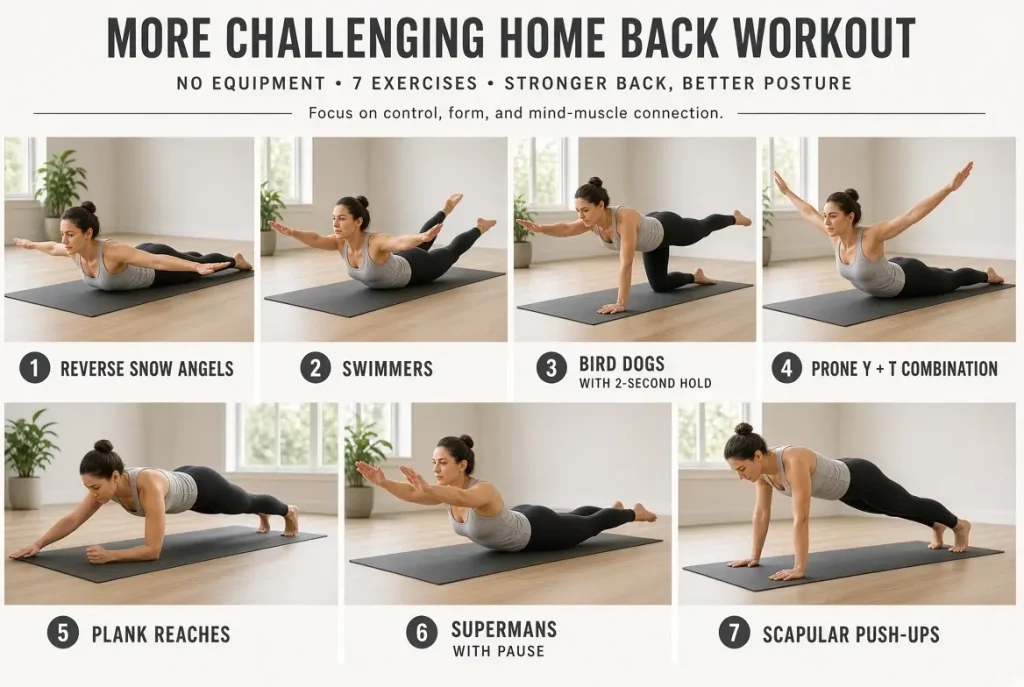
Once the beginner version feels solid, try this version. Rest 30–45 seconds between sets.
- Reverse Snow Angels – 3 sets of 8–10
- Swimmers – 3 sets of 20–30 seconds
- Bird Dogs with 2-second hold – 3 sets of 8 per side
- Prone Y + T combination – 3 sets of 8 each
- Plank Reaches – 3 sets of 6–8 per side
- Supermans with pause – 3 sets of 10
- Scapular Push-Ups – 3 sets of 10–12
This no-equipment back workout increases volume and control demands.
How to Make the Workout Harder
Without equipment you still have options:
- Slow the tempo (3 seconds up, 3 seconds down).
- Pause 2–3 seconds at the hardest point.
- Add 1–2 extra reps or an extra set.
- Improve range of motion while keeping form clean.
- Shorten rest periods gradually.
- Combine two moves (for example, Y raise into W raise).
Small, consistent increases keep the stimulus fresh.
Common Mistakes
Rushing through reps, holding the breath, letting the lower back take over, and shrugging the shoulders are the most frequent issues. Quality always beats quantity. Film yourself occasionally or check form in a mirror if possible.
Safety Advice
Stop immediately if you feel sharp pain, numbness, tingling, or pain that travels into the legs or arms. People with existing back pain, previous injuries, or who are pregnant should consult a qualified professional before starting. Normal muscle effort feels like controlled work and mild fatigue. Warning signs include sudden sharp pain, dizziness, or joint discomfort that worsens. When in doubt, reduce range or skip the move.
Weekly Schedule and Progress Expectations
Aim for 2–3 sessions per week with at least one rest day between them. Pair this work with walking, mobility, or light core work on other days if desired. Beginners often notice better control and posture awareness within 3–6 weeks of consistent practice. Endurance improves next. Strength and shape changes take longer and depend on overall training, nutrition, sleep, and recovery. Results vary; focus on how you feel and move rather than a fixed timeline.
Posture and Daily Habits
Strengthen the back muscles, then support them throughout the day. Sit with feet flat and shoulders relaxed. Stand tall with weight evenly distributed. Take short movement breaks every 30–60 minutes if you sit for long periods. Sleep in a position that keeps the spine neutral. These exercises to improve posture work best when daily habits reinforce them. Proper nutrition, enough sleep, and balanced overall training also influence how your back adapts.
FAQ
Can I train my back exercises at home without equipment?
Yes. Bodyweight patterns effectively challenge the upper, mid, and lower back for endurance, control, and posture support.
What is the best no-equipment back exercise?
Bird dogs and prone Y raises rank high for beginners because they teach control with low risk when performed correctly.
How often should I do a back exercises at home without equipment?
Two to three times per week with rest days in between works well for most beginners.
Can bodyweight exercises build back muscle?
They build endurance and can contribute to modest size gains over time, especially for beginners. Significant hypertrophy usually requires progressive external resistance
.Are supermans safe for everyone?
Not always. People with certain back conditions should modify or avoid them. Start gently and stop if anything feels wrong.
How can I work my lats without a pull-up bar?
Direct lat loading is limited without a bar or bands. Focus on scapular control, prone raises, and overall posture work while accepting the limitation.
Can back exercises improve posture?
Yes. Strengthening the upper and mid-back muscles and practicing better daily habits often leads to noticeable posture improvements.
Conclusion
You now have a complete set of back exercises at home without equipment, two clear routines, and practical ways to progress. Start with the beginner session, prioritize form, and stay consistent. Your back will thank you with better control, improved posture, and greater confidence in daily movement. Pick one routine, clear a small space on the floor, and try your first session this week. Small steps add up.
Explore moe article: Walking vs. Running for Weight Loss: Which Actually Works Better? (Science + Real Results)

Fitness Specialist & Former Tactical Trainer
Bal Krishna Poudel has spent more than 19 years in law enforcement organization, and fitness has been at the center of it all. He knows physical conditioning, dynamic strength training, and everyday wellness inside and out. For close to two decades, he taught at official police training centers, getting officers ready for the physical demands of the job—building their endurance and operational fitness. These days, he coaches people in his local community on strength and fitness. At 49, he doesn’t just talk about staying active—he lives it, showing up every day to train and move. He writes for Bodylix, where he shares workouts and nutrition advice that regular readers can actually use, backed by science and built around one goal: helping people stay strong and healthy for the long haul.

2 Responses