
Dip Station Workout: 12 Exercises for a Full-Body Power Tower Routine
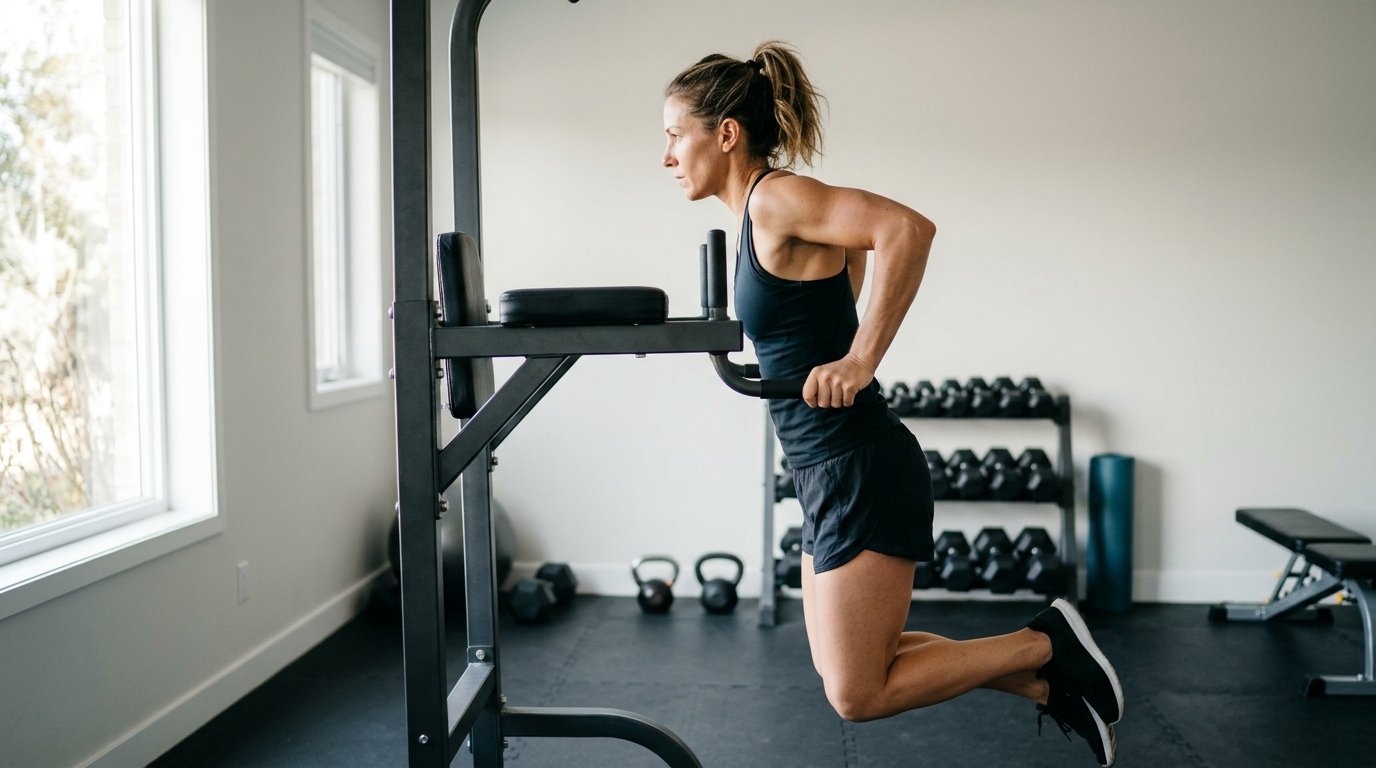
A dip station workout builds chest, back, arms and abs from a frame about the size of a coat rack. Sounds like a sales line. It isn’t.
Here’s the usual home gym mess: a tiny room, a tight budget, a bench that’s now a laundry shelf. A power tower dodges most of that. Bars for dips, a bar for pull-ups, a padded captain’s chair for leg raises. You’re the weight, and you pick how heavy.
Below you’ll find 12 power tower exercises by muscle group, steps for each, a few honest form notes, and dip station workout routines from beginner to advanced. New to the gear itself? Read our Power Tower Workout Guide first, then come back.
When I first set up a power tower in my garage, I honestly thought it would turn into a glorified clothes rack within a month. Instead, mastering basic parallel dips changed my upper body pressing strength in a way standard bench presses never did. It took a few weeks of shaky reps and sore shoulders to dial in my form, but learning to control my own body weight changed how I train. Years later, it’s still the one piece of gear I recommend to anyone serious about building functional strength at home.
What is a dip station or power tower?
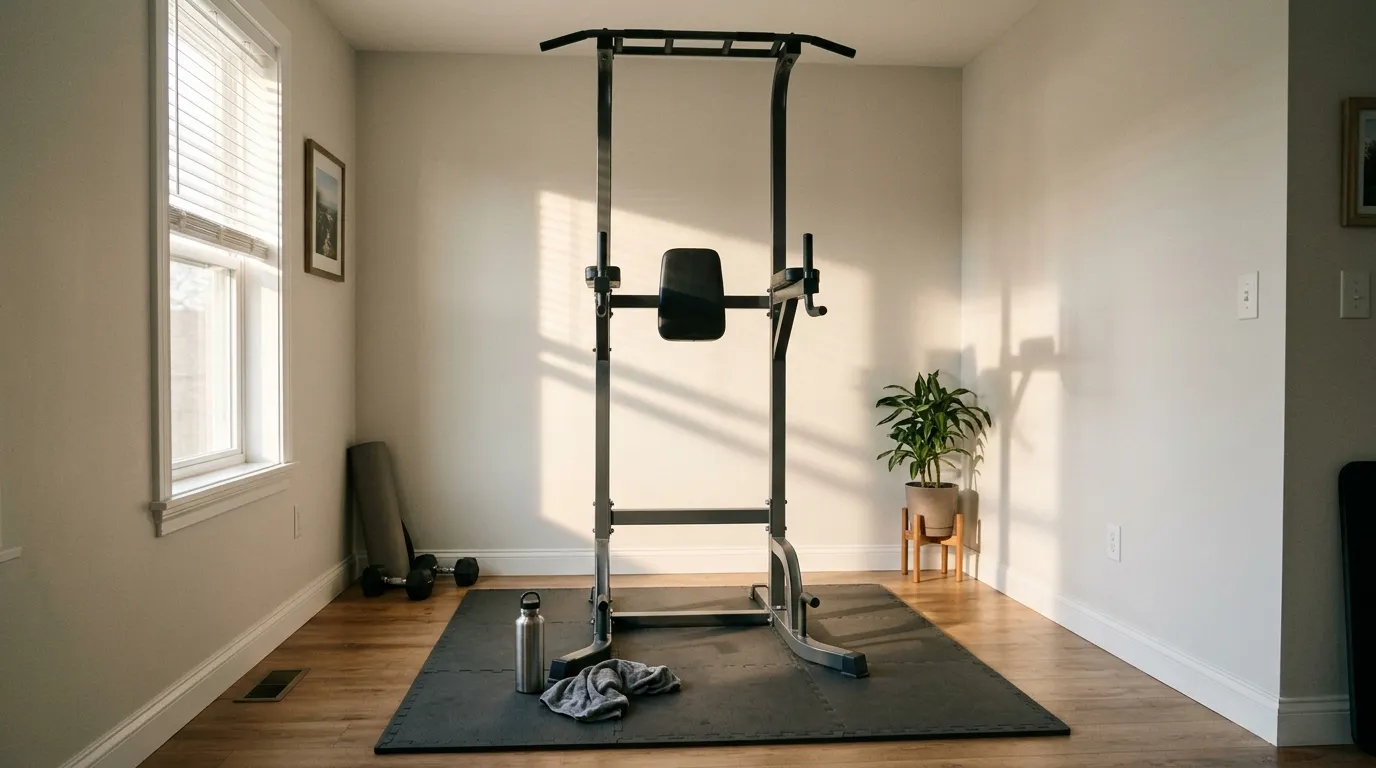
Two names, two slightly different machines. A dip station is two parallel handles on a frame, about hip to chest height. A power tower is the same frame plus a pull-up bar, a back pad and a captain’s chair for vertical knee raises.
| Feature | Dip stand | Power tower |
|---|---|---|
| Dips and L-sits | Yes | Yes |
| Pull-ups and chin-ups | Usually no | Yes, bar on top |
| Vertical knee raises | Only with a back pad | Yes, captain’s chair |
| Push-up handles | Often | Often |
| Floor space | Smaller, some fold | Bigger, usually fixed |
| Best for | Dips and push-ups in tight spaces | Chest, back and core in one spot |
Primary benefits of a dip station workout
Overload without plates. Lower for three seconds. Pause at the bottom. Add a rep each week, put your feet up on something, and once all that’s easy, strap on a weight belt.
On muscle: a 2017 meta-analysis found light and heavy loads grew muscle about the same, though heavy loads won on max strength [1]. So you don’t need a barbell, but your sets do need to get hard. Dips, pull-ups and rows cover chest, triceps, shoulders and back.
Joints get an easy ride too, since nothing pounds the floor, and your core is bracing on pretty much every rep. Feed it properly, though. Our list of low-calorie, high-protein foods is a decent starting point for any dip station workout.
12 power tower exercises by muscle group
Twelve moves, three muscle groups: chest and triceps, back and biceps, core. Think of these as the essential power tower exercises by muscle group for any dip station workout. Each has quick steps, so you can read a line, do a set, read the next.
Power Tower Exercises by Muscle Group: Chest and Triceps
Four pushing moves for your dip station workout. Two are the same dip with a different lean.
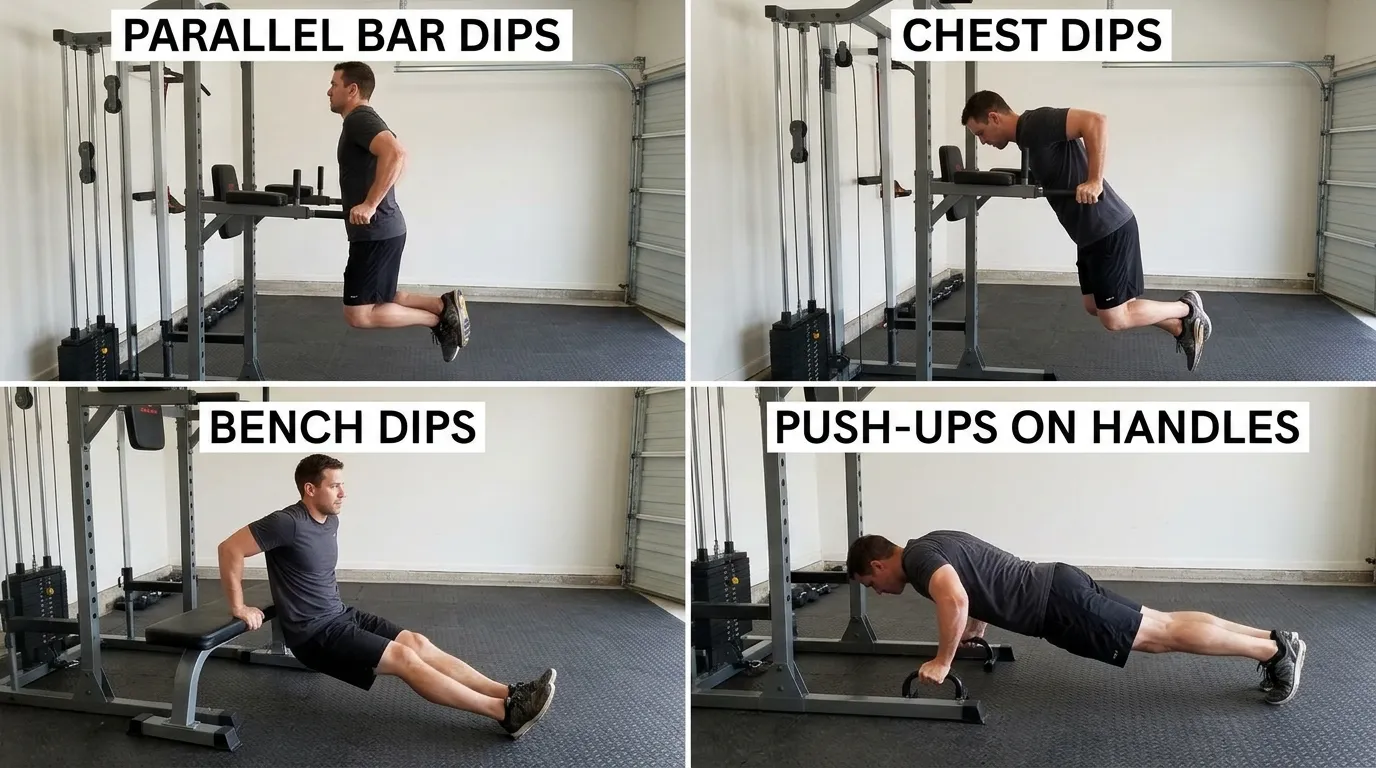
1. Classic Parallel Bar Dips Target muscles: lower and mid chest, front delts, triceps.
Grip the bars, lock out, and pull your shoulders down away from your ears. Lower until your upper arms are about parallel to the floor (a little short is fine if your shoulders grumble), then press back up. Lean forward and the chest works more. Stay upright and it’s mostly triceps. Same move, different job.
2. Chest Dips (Forward Lean) Target muscles: lower pectorals.
- Cross your ankles behind you and tip your torso forward.
- Let your elbows flare a bit and lower until your chest stretches, then drive up.
If that lean makes the front of your shoulder ache, go shallower. Smooth and short beats deep and shaky.
3. Triceps Bench or Bar Dips Target muscles: triceps brachii.
Sit on the edge of a stable bench, hands beside your hips, and slide off. Bend to about 90 degrees with your elbows pointing back, then press up. Keep your back close to the bench, always. Drift forward and your shoulders pay for it. On the tower itself, do the bar version with your torso upright.
4. Push-Ups on Dip Station Handles Target muscles: chest, core, serratus anterior.
- Grip the handles (or the bars at floor level) with your body in one straight line.
- Lower until your chest drops below handle height. You get more range than on the floor.
- Press up and push the floor away at the top to wake up the serratus.
- Don’t let your hips sag.
Handles keep your wrists neutral, which is a small win if floor push-ups bother them.
Back and Biceps Exercises for Your Dip Station Workout
Pulling is where most home setups fall down. A tower fixes that.
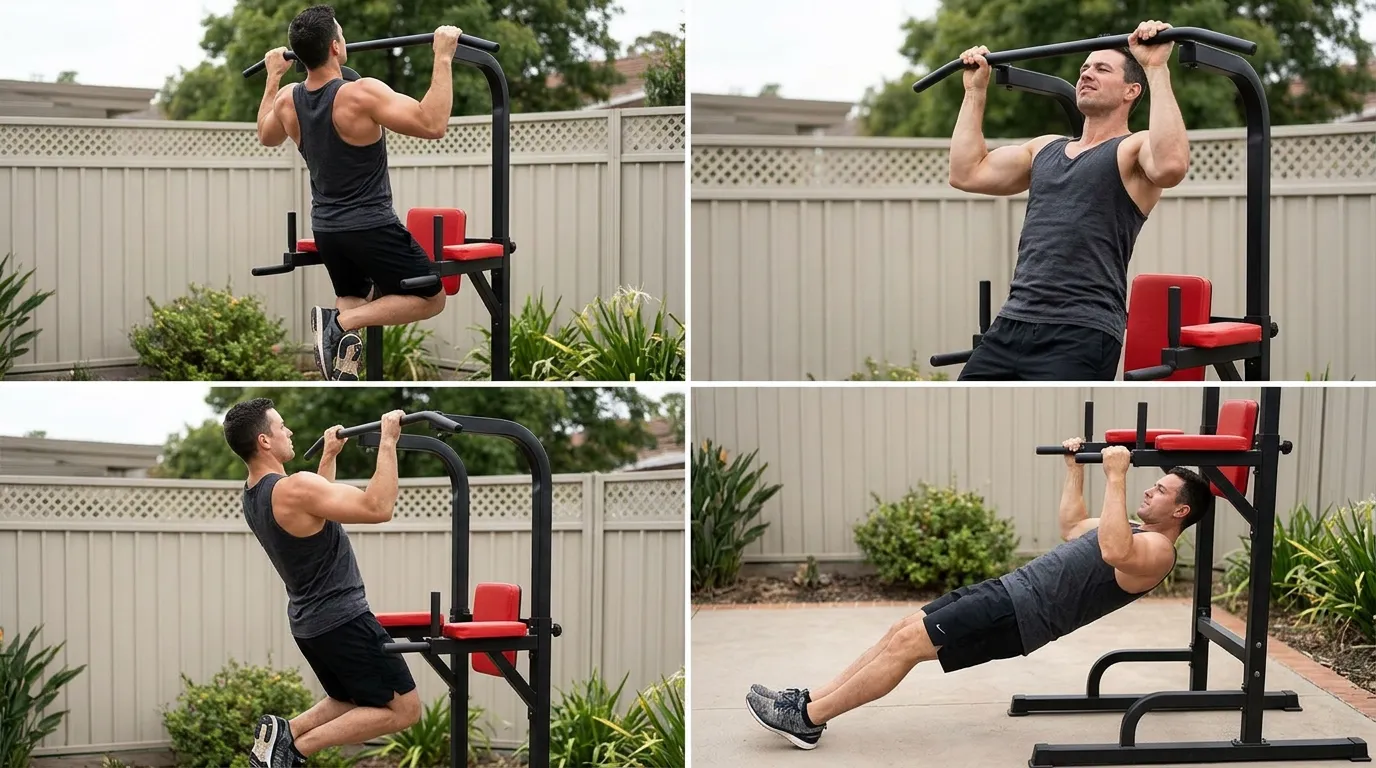
5. Overhand Pull-Ups Target muscles: latissimus dorsi, rhomboids, upper back.
- Hang just wider than your shoulders, palms facing away.
- Pull your shoulder blades down first, then drive your elbows toward your ribs until your chin clears the bar.
- Lower for two or three seconds.
Can’t do one yet? Step up to the top and lower yourself slowly, three to five times. That’s how most people land their first rep.
6. Underhand Chin-Ups Target muscles: biceps brachii, lats.
Same idea with palms facing you and a shoulder-width grip. Chin over the bar, chest tall, lower with control. Most people find these easier than pull-ups because the biceps pitch in, so use them as a stepping stone.
7. Neutral Grip Pull-Ups Target muscles: brachialis, upper lats.
Palms face each other on the parallel handles. Pull your elbows down and in until your chin passes your hands. Plenty of lifters find it kinder on wrists and shoulders, so if your tower has those handles, try it.
8. Inverted Rows (Australian Pull-Ups) Target muscles: mid-back, trapezius, rear delts.
- Lie under a low bar or the low dip handles, body straight, heels on the floor.
- Pull your chest to the bar and squeeze your shoulder blades together.
- Lower until your arms are straight.
Bend your knees to make it easier, raise your feet to make it harder. And give the frame a wiggle before you trust it with a pulling load.
Core Exercises for a Dip Station Workout (Captain’s Chair)
Core work in a dip station workout comes two ways: the captain’s chair and the pull-up bar. Use both.
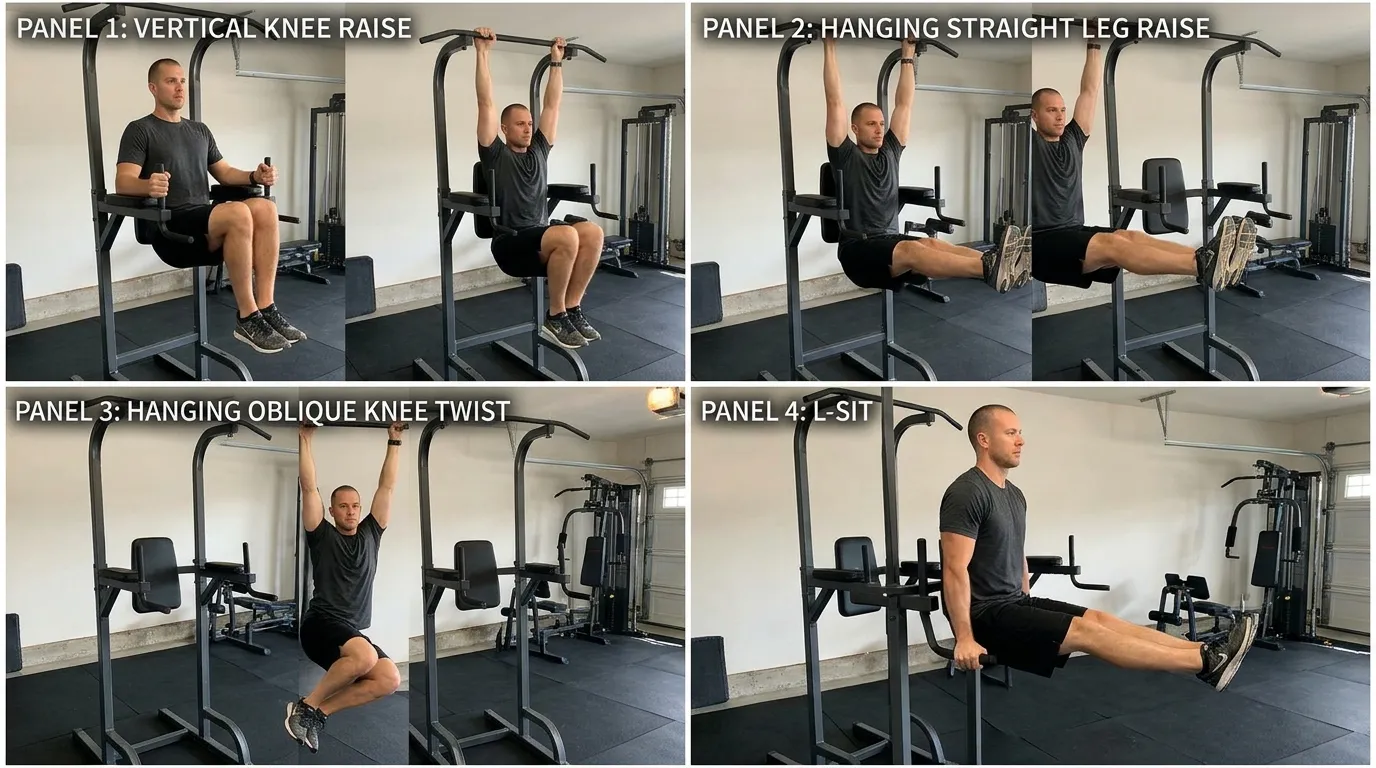
9. Captain’s Chair Vertical Knee Raises Target muscles: rectus abdominis, hip flexors.
Forearms on the pads, back flat. Curl your knees toward your chest and tilt your pelvis up at the top. That tilt is the whole point. Skip it and your hip flexors take over. Lower slowly, no swinging.
10. Hanging Straight Leg Raises Target muscles: lower abs, core stabilizers.
- Hang with your shoulders pulled down.
- Raise straight legs to hip height or higher.
- Lower over a slow count of three.
Swinging? Bend your knees until you can stay still.
11. Hanging Oblique Knee Twists Target muscles: internal and external obliques.
Hang, lift your knees to hip height, then rotate them toward one elbow. Rotate from the ribs, not by flinging your legs. Slow reps. A fast twist is mostly momentum and hope.
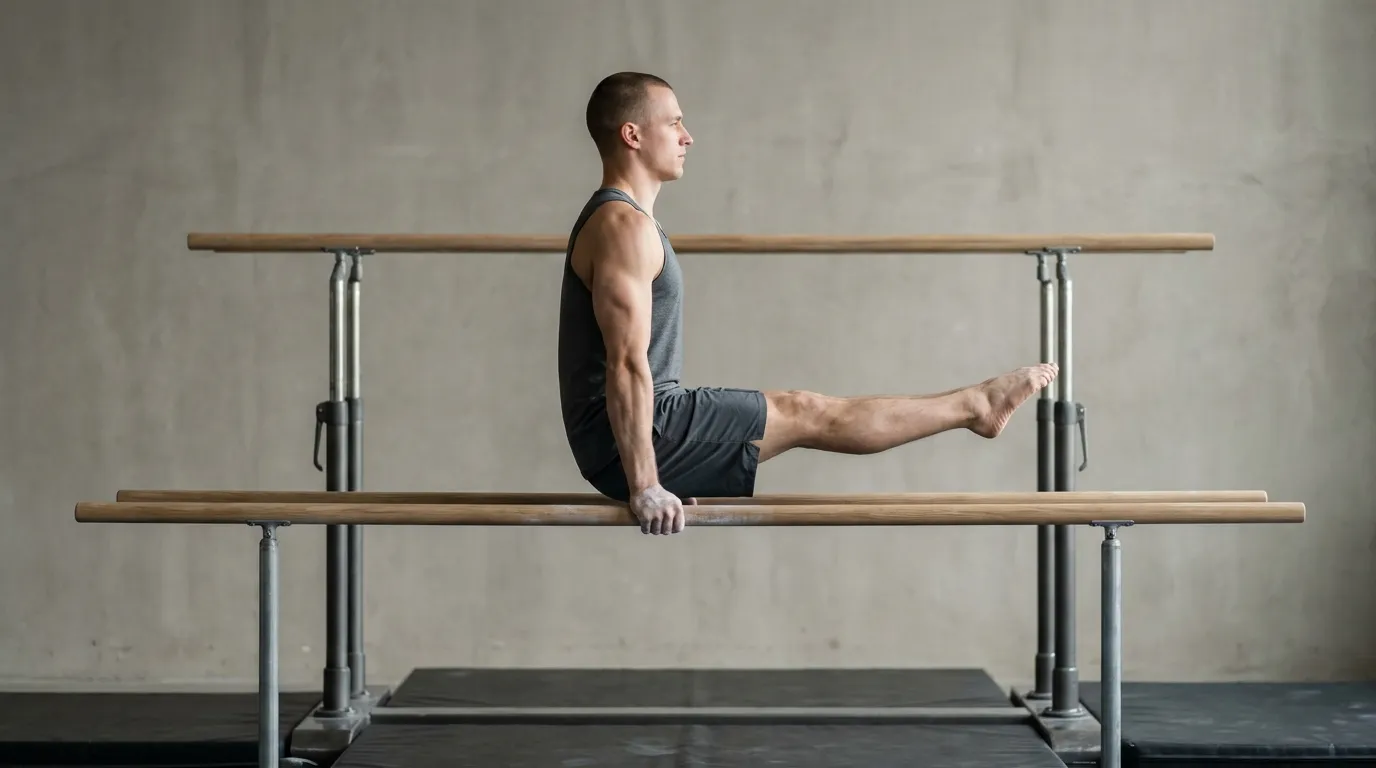
12. L-Sit Hold and Variations Target muscles: isometric core, dynamic shoulder stability.
- Press up on the dip bars and shove your shoulders down.
- Lift your legs straight out in front and hold.
- Start tucked (knees bent) for 5 to 10 seconds.
Move to one leg out, then both, as holds get easy. It looks simple in photos. It isn’t.

If I had to keep only four of these power tower exercises by muscle group, I’d pick parallel dips, pull-ups, inverted rows and knee raises. Everything else is flavor.
Power tower workout plan for every level
Pick your level honestly. Whichever power tower workout plan you choose, warm up, stop sets a rep or two before failure, and move up only when you’ve hit the top of every rep range. The WHO recommends muscle-strengthening on at least two days a week [2], and all three plans clear that.
Beginner power tower workout plan (3-day split)
Aim: learn the moves. Monday, Wednesday and Friday works, or any three days with a rest day between. Budget 30 to 40 minutes. On assisted dips your feet stay on the floor and your legs share the load. Totally new? Our power tower workout for beginners goes even slower, and the beginner gym workout plan sorts your leg days.
| Exercise | Sets x reps | Rest |
|---|---|---|
| Assisted dips (feet on the floor) | 3 x 6-8 | 90 sec |
| Push-ups on handles | 3 x 8-10 | 90 sec |
| Inverted rows | 3 x 8-10 | 90 sec |
| Captain’s chair knee raises | 3 x 8-10 | 60 sec |
| Triceps bar dips | 2 x 6-8 | 60 sec |
Intermediate dip station workout (4-day full-body split)
You’re here if you can string together a few strict dips and a couple of pull-ups. Push, pull, core, then one full-body finisher. Lifting somewhere else too? Our full-body gym plan fits around this.
| Day | Focus | Exercises (sets x reps) | Rest |
|---|---|---|---|
| Day 1 | Push | Parallel dips 4 x 6-10, chest dips 3 x 8-10, handle push-ups 3 x 12-15 | 90 sec |
| Day 2 | Pull | Pull-ups 4 x 5-8, chin-ups 3 x 6-8, inverted rows 3 x 10-12 | 90 sec |
| Day 3 | Core | Knee raises 3 x 10-12, straight leg raises 3 x 8-10, oblique twists 3 x 8 per side, L-sit 3 x 10-20 sec | 60 sec |
| Day 4 | Full body | Parallel dips 3 x 8, neutral grip pull-ups 3 x 6, knee raises 3 x 12 | 90 sec |
Advanced power tower workout plan and calisthenics circuit
Now it gets spicy. Weighted dips and pull-ups for strength, timed rounds for stamina. Keep the strength day and the circuit day apart, and treat this advanced dip station workout as a block you cycle through. Not a daily grind.
| Format | What you do | Rest |
|---|---|---|
| Strength day | Weighted dips 4 x 6-8, weighted pull-ups 4 x 5-6, L-sit 4 x 15-20 sec | 2-3 min |
| AMRAP 15 minutes | 5 pull-ups, 8 dips, 10 hanging leg raises, repeat for as many rounds as you can | None, pace yourself |
| Finisher | 3 rounds: 30 sec L-sit attempt, 30 sec rest, 30 sec hanging knee twists, 30 sec rest | As built in |
Rep ranges are starting points, not laws. Ahead of them? Add a pause or a belt. Behind? Drop a set. And if you’d rather be handed a month than build your own, our 30-Day Fitness Reset is there.
Foldable Power Tower Pull Up Dip Station, Pull Up Bar Free Standing
No frame yet? This Amazon listing is one option for a dip station workout at home. Check size, weight limit and what’s in the box before you order.
This page may contain affiliate links. If you buy through them, Bodylix may earn a commission at no extra cost to you. This is general information, not medical advice.
Form tips and injury prevention
Rushing, swinging, skipping the warm-up. That’s where most dip station workout injuries start. Fix those and you’re most of the way there.
Shoulder position in a dip station workout
Before you bend your elbows, pull your shoulder blades down and a touch back. Chest proud, shoulders away from your ears, held for the whole set. Feel a pinch at the front of the shoulder at the bottom of a dip? Stop higher. Those shaky reps and sore shoulders I mentioned earlier were mostly this.
Stop swinging on hanging leg raises
Swinging turns an ab move into a pendulum. Squeeze your glutes, brace your ribs, start from dead still, and halve the reps if you can’t stay put. Ten clean beat twenty wild.
Warm-up for your dip station workout
- Wrist circles and gentle wrist rocks on the floor, 30 seconds each way.
- Arm circles and shoulder rolls, 10 slow ones each direction.
- Scapular pull-ups on the bar: hang, then shrug your shoulders down, 2 sets of 8.
- One easy set of your first exercise, about half effort.
That’s about five minutes, and it’s the cheapest insurance in any dip station workout. Sore the next day? Our best muscle recovery tools kit might help.
Dip station workout FAQ
Can you build muscle with just a dip station?
Yes, as long as you keep making it harder. A 2017 meta-analysis found light loads grow muscle about as well as heavy ones when sets get close to failure. So a dip station workout with slow reps, pauses and extra reps works. Add a pull-up bar or low bar for your back.
What is the difference between a dip stand and a full power tower?
A dip stand is two parallel bars: dips, L-sits, push-up variations. A power tower adds a pull-up bar, a back pad and a captain’s chair for knee raises. So the tower covers chest, back and core in one spot. The stand takes less room, and some fold away.
How many times a week should I do a dip station workout?
Three or four sessions suits most people. The World Health Organization recommends muscle-strengthening on at least two days a week, so two full-body sessions is the floor, not the ceiling. Beginners do fine on three non-consecutive days. Intermediates can split push, pull and core across four.
How do I train lower body and legs on a power tower?
Honestly, the tower is poor for legs. Hanging raises work abs and hip flexors, not quads or glutes. Pair your power tower workout plan with floor work like squats, lunges, step-ups and glute bridges, and add them to the end of two sessions a week.
Are dips bad for your shoulders?
Not automatically. Deep dips do load the front of the shoulder hard, though. Keep your shoulders down and back, stop where the joint feels fine, and skip the move if it pinches. Pain that hangs around after a session is a reason to see a physio or doctor.
What I’d actually do
Start with handle push-ups and inverted rows for four weeks, and keep deep dips for later. I know, dips are the star. But your shoulders need a base, and they’ll thank you by progressing faster.
Then three days a week, plus two floor leg exercises. Leave the L-sit alone until knee raises feel boring. Pick one power tower workout plan, run it for a month, and write your numbers down instead of rewriting the plan every week.
14 Day Rapid Soup Diet
A soup-based diet program from ClickBank’s Diets & Weight Loss category. It’s separate from this workout. Read the sales page to see exactly what it includes.
See the program →Disclaimer. This article is for general education and isn’t medical advice. Results vary from person to person. Check with a doctor or qualified professional before starting a new exercise program, especially if you have shoulder, elbow, wrist, back or heart concerns, pain, or an injury. Stop any exercise that causes sharp or lasting pain.
Sources
- Schoenfeld BJ et al. “Strength and hypertrophy adaptations between low- vs. high-load resistance training: a systematic review and meta-analysis” (2017).
- Bull FC et al. “World Health Organization 2020 guidelines on physical activity and sedentary behaviour,” British Journal of Sports Medicine (2020). Full text: WHO Guidelines on Physical Activity and Sedentary Behaviour.
For more practical health and nutrition guides, visit bodylix.com

Fitness Specialist & Former Tactical Trainer
Bal Krishna Poudel has spent more than 19 years in law enforcement organization, and fitness has been at the center of it all. He knows physical conditioning, dynamic strength training, and everyday wellness inside and out. For close to two decades, he taught at official police training centers, getting officers ready for the physical demands of the job—building their endurance and operational fitness. These days, he coaches people in his local community on strength and fitness. At 49, he doesn’t just talk about staying active—he lives it, showing up every day to train and move. He writes for Bodylix, where he shares workouts and nutrition advice that regular readers can actually use, backed by science and built around one goal: helping people stay strong and healthy for the long haul.
